

Table of Contents
- Dirtco vs Offroadlife: What Sets These Brands Apart
- Heavyweight Off-Road T-Shirts: Design and Graphic Range
- Rock Crawling Shirts: Durability and Construction
- Fabric Quality and Garment Construction
- Sizing, Fit, and Comfort Comparison
- Dirtco Alternatives: Why You Might Look Beyond
- Shipping, Returns, and Customer Service
- Which Brand Should You Choose?
- Frequently Asked Questions
Last Updated: October 8, 2026
Dirtco vs Offroadlife: What Sets These Brands Apart
Shopping for off-road apparel means choosing between Dirtco and Offroadlife on more than logos. Both target riders, crawlers, and trail enthusiasts, but fabric quality, design, and real-world performance matter more than marketing claims.
At The Trail Explorer, we know what separates a shirt that falls apart after a season from one that holds up to mud, rocks, and repeated washing.
The real question is which brand matches your budget, body type, how hard you push your gear, and whether you prefer subtle or bold designs.
Heavyweight Off-Road T-Shirts: Design and Graphic Range
Both brands build their reputations on heavyweight cotton tees celebrating the off-road lifestyle. The difference is execution and range.
Dirtco leans into bold graphics: large-scale imagery of crawlers tackling obstacles, vehicles mid-air, and thematic text, with vibrant color retention across prominent chest and back prints.
Offroadlife spans bold to understated, from full-chest graphics to small sleeve or pocket logos, appealing to a broader audience while still celebrating off-road culture.
If you ride trails without the social club scene, Offroadlife lets you express your passion without feeling like a billboard.
Rock Crawling Shirts: Durability and Construction
A rock crawling shirt must survive abrasion, repeated washing, and the wear that separates premium gear from everything else.
Dirtco uses a heavier-weight cotton blend with reinforced stitching on stress points, a ribbed collar, and double-stitched seams in high-wear areas.
Offroadlife uses similar construction with a lighter cotton blend.
If durability is your priority, Dirtco's heavier construction is the safer bet. Offroadlife handles moderate to heavy use, but Dirtco gives more confidence if you push your gear to its limits every weekend.
Fabric Quality and Garment Construction
Most reviews stop at "heavier is better," which doesn't help when both shirts cost real money. Here's how to verify what you're buying on each brand's product listings before you check out.
Read the fabric composition line, not the marketing copy
The most useful field on any listing is fiber content. Dirtco tees read as a high-cotton blend, typically cotton with a small percentage of polyester for shape retention. Offroadlife tees blend cotton with a stretch fiber (spandex or elastane) in the low single digits, the reason an Offroadlife shirt moves differently.
If a listing doesn't publish fiber content, treat that as a red flag. A brand confident in its materials prints them.
Garment weight: what the numbers actually mean
Fabric weight, measured in ounces per square yard (oz/yd²), predicts how a shirt feels and how long it lasts. The practical scale for cotton tees:
- 4.0-4.5 oz/yd², light, summer-weight, prone to showing wear quickly
- 5.0-5.5 oz/yd², mid-weight, the standard for most retail graphic tees
- 6.0-6.5 oz/yd², heavyweight, structured, holds its shape through repeated washing
- 7.0 oz/yd² and up, workwear territory, stiff at first, extremely durable
Dirtco's tees sit in the heavyweight band; Offroadlife's in the mid-weight band, with stretch fiber doing the work extra ounces would. Neither is wrong, heavyweight cotton resists abrasion and holds a graphic's shape, while mid-weight cotton with stretch breathes better and moves with you.
Construction details worth checking
Weight gets attention, but construction determines whether a shirt survives its second season. Four things to inspect:
- Collar construction. A ribbed collar with a taped neck seam resists stretching out. A plain, untaped collar will curl within a few months.
- Shoulder seams. Double-stitched shoulder seams, sometimes called a "coverseam", are the difference between a shirt that holds its shape and one that sags.
- Side seams. A true side-seamed shirt (versus a tubular body) fits closer to the body and twists less in the wash. Check the product photos for a seam running down the side.
- Graphic application. Screen-printed graphics on heavyweight cotton tend to outlast heat-transfer or direct-to-garment prints, especially after repeated washing. Look for language like "screen print" or "plastisol ink" in the listing.
Both brands use reinforced stitching at stress points and ribbed collars, so the baseline is comparable. The difference shows up in the details above.
Pre-shrinking and wash behavior
Cotton shrinks; the question is whether the brand controls it. "Pre-shrunk" means the fabric was washed or treated before cutting, so the shirt arrives close to its final size. Without it, expect roughly 3-5% shrinkage on the first wash, about an inch on a 30-inch body length.
Dirtco's heavyweight cotton is pre-shrunk, so the fit stays consistent after the first wash. Offroadlife's stretch fiber naturally resists shrinkage. Either way, wash cold and tumble low, heat drives shrinkage and graphic cracking.
The bottom line on materials
For a shirt that feels substantial and holds its structure for years, choose Dirtco's heavyweight cotton. For one that moves with you and breathes in warm conditions, choose Offroadlife's mid-weight stretch blend. The mistake is assuming one is objectively better without checking the fiber content and weight on the listing you're buying from.
Sizing, Fit, and Comfort Comparison
Sizing is where online apparel shopping goes wrong most often. Here's a practical framework: what to measure, what to look for on each size chart, and how to decide between two sizes.
Measure these three things first
Before any size chart, take three measurements with a soft tape measure while wearing a shirt you like the fit of.
- Chest, measure around the fullest part of your chest, under your arms, keeping the tape level.
- Body length, measure from the highest point of your shoulder (where the neck seam meets the shoulder) straight down to the hem of a shirt you like.
- Sleeve length, measure from the center back of your neck, across the shoulder, and down to the sleeve hem.
Write those three numbers down. Every size decision below comes back to them.
How to read a size chart like a fitter
A size chart gives garment measurements, not body measurements. If your chest measures 42 inches and a Large lists a 44-inch chest, that's 2 inches of ease, comfortable without looking baggy. A 42-inch garment is a slim fit; a 46-inch is relaxed.
A common pattern across off-road apparel brands:
- Dirtco charts tend to show more ease in the chest and shoulders, and a longer body length. That's a cut built for broader frames and longer torsos.
- Offroadlife charts tend to show less ease and a shorter body length, with a more tapered waist. That's a cut built for a closer, more modern fit.
Neither is better. They're different body types served by different patterns.
Choosing between two sizes
This question costs people money on returns. How to decide:
- If you're between sizes and want a relaxed fit, size up. Cotton shirts that are slightly loose look intentional; shirts that are slightly tight look like a mistake.
- If you're between sizes and want a fitted look, size down, but only if the garment chest measurement is still at least 2 inches larger than your body chest measurement.
- If you have a long torso, prioritize body length over chest ease. A shirt that's 1 inch too wide looks fine; a shirt that's 2 inches too short rides up every time you reach for something.
- If you have broad shoulders, check the shoulder-to-shoulder measurement on the size chart, not just the chest. A shirt can have plenty of chest room and still pull across the shoulders.
Fit notes by brand
Dirtco runs close to standard men's sizing: if you wear a Large in most American brands, start there.
Offroadlife runs more fitted, a Large may feel closer to a Medium elsewhere. That suits a tailored look or leaner build. If you're broader or longer-limbed, size up, knowing it adds fabric through the waist as well as the chest.
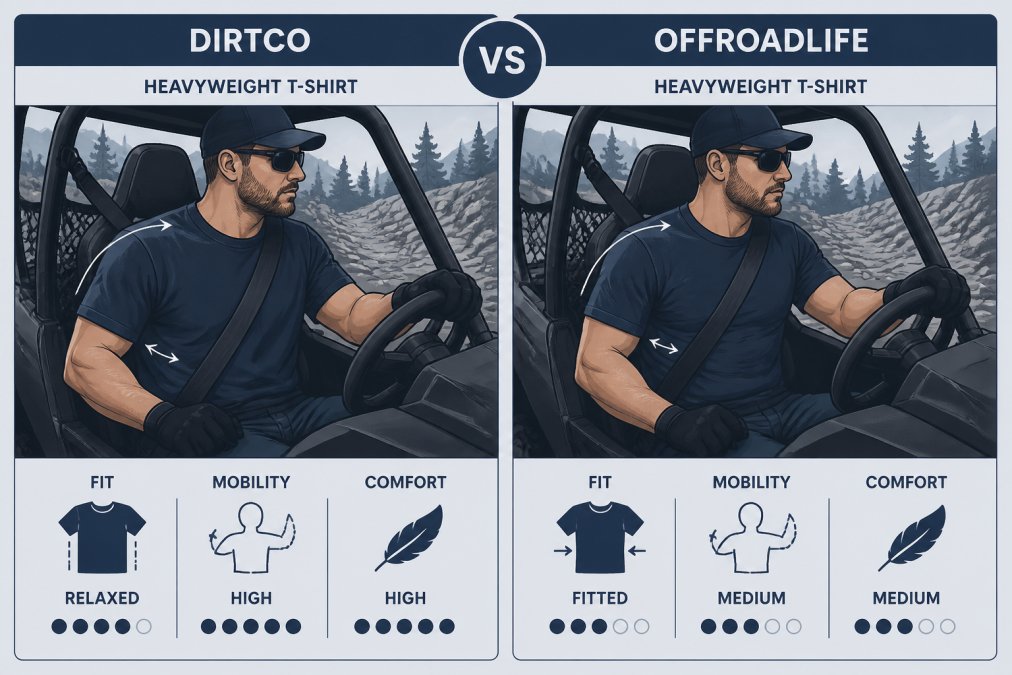
Comfort during activity
Offroadlife's stretch blend moves with you during reaching, climbing, and dynamic movement, the fabric gives instead of pulling. Dirtco's heavier cotton is stiffer out of the bag and softens over the first few washes into a broken-in feel.
In heat, the mid-weight Offroadlife breathes noticeably better; in cool conditions, the heavier Dirtco holds warmth and blocks wind more effectively. That's a real trade-off.
A quick decision path
- Broad chest, long torso, want a relaxed fit → Dirtco, your usual size.
- Lean build, average torso, want a fitted look → Offroadlife, your usual size.
- Between sizes, want room to move → size up in either brand.
- Between sizes, want a tailored look → Offroadlife, size down if the chest measurement allows.
- Tall or long-torsoed → Dirtco, or size up in Offroadlife and accept extra waist fabric.
If unsure, order both sizes where returns allow, try them back-to-back, and return the one that doesn't work. A little return shipping beats guessing wrong on a shirt you'll wear for years.
Dirtco Alternatives: Why You Might Look Beyond
The most common objection to Dirtco is price. It positions itself as premium, costing more than generic outdoor brands, so paying more requires justification beyond the brand name.
The justification is durability and design specificity. Carhartt is built for work and industrial labor, not the off-road lifestyle, and generic outdoor brands are built for general use.
Where Dirtco falls short is flexibility. If you want subtle branding or a lighter shirt for warm conditions, its bold, heavy approach doesn't adapt, which is where Offroadlife enters the conversation.
Shipping, Returns, and Customer Service
Both brands are e-commerce businesses, so the buying experience matters as much as the product.
Dirtco ships standard with delivery in 5-7 business days and accepts returns within 30 days, though you cover return shipping, so a sizing mistake costs you money.
If fit concerns you, Offroadlife's longer window reduces risk, more time to wash the shirt and see how it holds up.
Neither brand offers free return shipping on all returns, so account for potential return costs when comparing prices.
Which Brand Should You Choose?
Choose Dirtco for maximum durability, bold graphics, and a shirt that gets better with age.
Choose Offroadlife for design flexibility, better comfort during active movement, and a longer return window.
Factor in your use case: how hard you push your gear, whether you prefer bold or subtle branding, and your body type and sizing history. Answer honestly, and the right brand becomes clear.
Finding the right off-road apparel means balancing durability, fit, and price. Dirtco excels at durability and bold expression; Offroadlife offers more flexibility and comfort.
Frequently Asked Questions
What is the main difference between Dirtco and Offroadlife off-road apparel?
Both brands focus on off-road lifestyle apparel, but they differ in design approach, fabric weight, and target audience. Dirtco emphasizes bold graphics and heavy-duty construction for serious rock crawlers, while Offroadlife offers a broader range of styles appealing to casual trail riders and outdoor enthusiasts. Comparing their heavyweight shirt options, sizing charts, and design catalogs will reveal which aligns with your aesthetic and fit preferences.
Are heavyweight off-road T-shirts worth the extra cost?
Heavyweight cotton T-shirts designed for off-road use offer better durability, color retention, and shrinkage resistance than standard apparel. For riders tackling mud parks and rocky terrain regularly, the thicker fabric withstands wear and tear better and lasts multiple seasons. If you ride occasionally or prefer lighter comfort, standard-weight options may suffice; for frequent trail use, the investment typically pays off.
How do you know if rock crawling shirts will actually fit right?
Check the brand's detailed size chart before ordering, paying attention to chest width, sleeve length, and torso length. Rock crawling shirts should allow freedom of movement for steering and climbing without excess fabric bunching. Read customer reviews mentioning fit details, especially from riders with similar body types. Most reputable brands offer returns if the fit doesn't work, so verify the return window and process before purchasing.
What should you look for in durable off-road apparel?
Look for heavyweight cotton or cotton-blend fabric (at least 6 ounces), reinforced stitching at stress points, and ribbed collars that resist stretching. Check that graphics use high-quality screen printing or embroidery that won't crack after washing. Read reviews specifically about color retention and shrinkage after multiple washes. Verify the brand tests garments for outdoor use and stands behind durability claims with a solid return or warranty policy.