

Table of Contents
- Why Restrictive Gear Ruins a Long Day Behind the Wheel
- Ergonomic Riding Gear Features That Actually Matter
- How to Layer for Off-Road Driving in Changing Conditions
- Getting the Fit Right: Sizing, Body Type, and Range of Motion
- Best Off-Road Apparel Brands and What to Look For
- Caring for Stretch Fabrics So They Last Season After Season
- Common Mistakes That Make Trail Gear Uncomfortable
- Conclusion
- Frequently Asked Questions
Last Updated: September 28, 2026
Why Restrictive Gear Ruins a Long Day Behind the Wheel
Stiff seams and tight cuts turn a fun trail day into a slow grind. The wrong gear limits your reach, rubs in the wrong spots, and drains your focus long before the trail does. That is why so many drivers ask how they can find comfortable, ergonomic off-road apparel that doesn't restrict movement while driving. This guide from The Trail Explorer breaks down what actually matters: fabric, cut, fit, and layering.
A common mistake is buying gear for looks first and comfort second. In practice, that choice shows up fast. You fight the wheel instead of reading the trail.
Discomfort also has a safety cost.
Ergonomic Riding Gear Features That Actually Matter
Ergonomic riding gear is apparel cut and built to move with your body, not against it. It uses stretch panels, curved seams, and breathable fabrics so you can steer, shift, and look around without fighting your clothes.
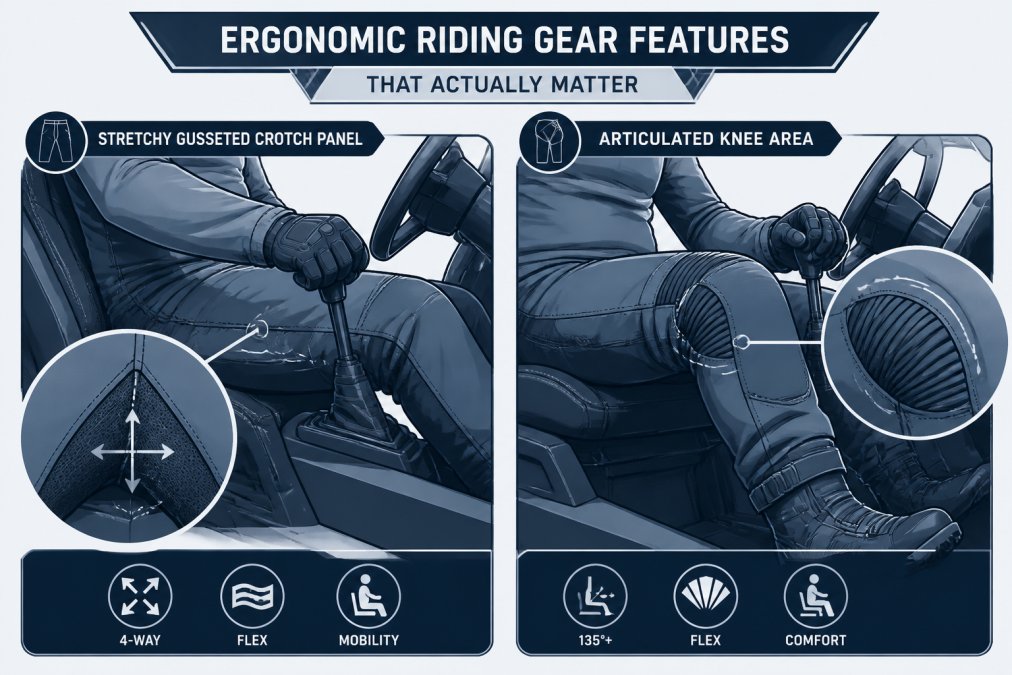
Articulated Panels, Pre-Curved Construction, and Stretch Zones
Articulated panels are extra fabric sections sewn into knees, elbows, and shoulders. They let joints bend without pulling the whole garment tight.
Moisture-Wicking Fabrics and Ventilation Ports
Moisture-wicking fabrics pull sweat away from your skin. This helps with chafing prevention on long, hot rides.
How to Layer for Off-Road Driving in Changing Conditions
Layering for off-road driving means building three thin layers instead of one thick one. This gives you climate control you can adjust as the day warms up or the trail climbs.
- Base layer: wicks sweat, sits close to skin
- Mid layer: traps heat, easy to remove
- Outer layer: blocks wind and water
Getting the Fit Right: Sizing, Body Type, and Range of Motion
Fit decides whether gear helps or hurts. A snug fit at the shoulders and hips keeps panels where they belong. Too loose, and fabric bunches. Too tight, and you lose range of motion. The problem is that "snug" means something different on every frame, and most sizing charts are built around a single athletic template that leaves a large share of drivers underserved.
Why Standard Sizing Fails Different Body Types
Off-road apparel is usually patterned on a standing, average-build model. That pattern breaks down in predictable ways once you sit down in a vehicle:
- Tall and slim frames. Standard torsos ride up when you reach for the wheel, exposing the lower back. Sleeves end short of the wrist. The fix is extended-length cuts, split hems, and articulated sleeves with a longer inseam measurement, not just a larger letter size.
- Broad shoulders and thick chests. A shirt that fits the chest will often be baggy at the waist, which lets fabric bunch under a harness or seatbelt. Look for athletic or tapered cuts with stretch zones at the underarm and side seam.
- Shorter torsos and stockier builds. Standard pants can gap at the waist while binding at the thigh. A gusseted crotch and a higher-rise waistband solve most of this. Adjustable waist tabs help more than a belt.
- Long legs, short torso. Knee articulation panels land in the wrong place on standard patterns, so the fabric pulls when you press the clutch or brake. Check that the articulated knee sits at your actual knee, not above or below it.
A Practical Fitment Guide for Taller and Bigger Riders
Bigger and taller drivers get left out of standard sizing. Here is how to fix that:
- Check the length measurement, not just the chest
- Look for extended length or split hems
- Size up for a relaxed fit if you have a longer torso
- Confirm the return policy before you buy
- Measure your seated torso length from shoulder to waistband, then compare it to the garment's listed back length
- For pants, measure your seated knee-to-hem length, not your standing inseam
The Seated Range-of-Motion Test
Before you commit to any piece, run this five-point check while seated:
- Grip an imaginary wheel at 9 and 3. Your shoulders should not feel pulled forward.
- Rotate your torso to look over your shoulder. The fabric at your waist should twist without binding.
- Press the clutch or brake pedal. Your knee should bend without the pant leg pulling at the thigh.
- Reach for the shifter or transfer case lever. Your elbow should move freely, with no tightness across the back.
- Sit for two full minutes. If you are already adjusting seams, the garment will fail on hour three.
Adjustability Beats Perfect Sizing
No off-the-shelf garment fits every frame perfectly. The pieces that work hardest for a wide range of bodies are the ones with adjustment built in: hook-and-loop waist tabs, elastic drawcords at the hem, adjustable cuffs, and removable liners. These features let you tune the fit as layers change through the day, which matters more than getting the letter size exactly right on the first try.
Best Off-Road Apparel Brands and What to Look For
The best off-road apparel brands share a few traits: real stretch, breathable fabric, and honest sizing charts. Skip brands that only sell graphics.
Judge any piece by these signals:
- Stretch zones at hips, knees, and shoulders
- Breathable, quick-drying fabric
- A clear fitment guide with measurements
- Stitching that holds up to abrasion
Caring for Stretch Fabrics So They Last Season After Season
Stretch fabrics lose their snap when you wash them wrong. Heat is the enemy. It breaks down elastic fibers and shrinks the panels that give you room to move.
- Wash cold on a gentle cycle
- Skip the dryer; hang to dry
- Avoid fabric softener, which coats the fibers
- Turn garments inside out to protect prints
Common Mistakes That Make Trail Gear Uncomfortable
Most comfort problems trace back to a few repeat errors. Fixing them costs nothing, but understanding why each one matters is what separates a gear list from a real ergonomic strategy.
- Buying for looks and ignoring the cut. Graphics and colorways sell, but the pattern is what determines whether you can reach the shifter. A good-looking shirt with a straight-cut torso will bind at the shoulders the moment you grip the wheel.
- Skipping the seated fit test. Standing in front of a mirror tells you almost nothing. Your posture behind the wheel is a different shape, and that is the shape the garment has to fit.
- Wearing cotton as a base layer. Cotton holds moisture against your skin instead of moving it away. On a long, hot drive that leads to chafing and a shortened day on the trail.
- Overdressing and trapping sweat. More layers is not the same as better layering. A shell over a heavy mid layer with no venting turns your torso into a sauna, and wet fabric loses its insulating value.
- Ignoring care labels on stretch pieces. Heat and fabric softener break down elastic fibers. A piece that felt great in month one can lose its give by month six if you wash it wrong.
- Wearing gear that is too tight at the waist. A waistband that digs in restricts breathing and circulation over a long drive, which compounds fatigue.
The Safety Cost of Discomfort
Discomfort is not just annoying. It is a safety issue, and most gear guides skip this entirely.
A Quick Self-Check Before You Hit the Trail
Run through this list before you leave the staging area:
- Can you reach every control without the fabric pulling?
- Is anything rubbing at the waist, shoulders, or knees?
- Are you already warm before you start moving?
- Can you twist to check your blind spot without binding?
Conclusion
Finding gear that moves with you takes a little homework, but the payoff is a full day of comfortable driving. Look for articulated panels, stretch zones, breathable fabric, and a fit you have tested while seated. The Trail Explorer builds apparel for exactly this: comfortable, high-quality garments with designs made for rock crawling and trail exploration. Check our heavyweight tees and headwear, and subscribe to our emails for new drops and trail-ready tips.
Frequently Asked Questions
What features make off-road apparel ergonomic?
The features that matter most are articulated panels at the knees and elbows, a gusseted crotch, pre-curved construction that matches a seated driving position, and stretch zones placed at the joints. Moisture-wicking technical fabrics, vented panels, and elastic waistbands round out the list. Together these reduce material bunching and chafing, so you can steer, shift, and brace without your clothing fighting you. Look at the panel layout before you look at the logo.
How should off-road driving gear fit for maximum mobility?
A snug fit at the shoulders and waist with room through the hips, knees, and elbows gives the best range of motion. Anything too loose bunches behind your knees and catches on shifters; anything too tight restricts reach and pulls at the seams. Test it by sitting in your vehicle and turning the wheel lock to lock. If the fabric pulls across your back or binds at the hip, size up or pick a cut with more stretch.
What materials are best for breathable, non-restrictive trail clothing?
Synthetic fibers and blends move moisture away from skin faster than plain cotton, which matters on long, hot drives. A breathable polyester mesh layer, like the Unisex Sports Jersey from The Trail Explorer, keeps air moving across your torso. For cooler mornings, a fleece mid-layer such as the Unisex Columbia Fleece Jacket adds warmth without bulk. Cotton has a place in mild weather, but it holds sweat and dries slowly, so keep it out of your base layer.
How do I balance durability with comfort in off-road apparel?
You do not have to choose one or the other. Look for abrasion-resistant panels at the shoulders, seat, and knees, where contact happens, and stretch fabric at the joints, where movement happens. A durable water repellent finish sheds trail dust and light rain without stiffening the fabric. Then maintain it properly: wash stretch blends in cold water and air dry them so the fibers keep their elasticity instead of breaking down in a hot dryer.