

Table of Contents
- Why Durable Clothing for Mud Riding Matters
- Essential Fabric Technologies for Off-Road Gear
- Heavyweight T-Shirts for Off-Roading: Build Quality Over Flash
- Waterproof vs. Water-Resistant Riding Apparel: Which Suits Mud Riding
- How to Clean Off-Road Riding Gear and Extend Its Life
- Layering and Fit: Building a Durable Mud Riding Setup
- Frequently Asked Questions
Last Updated: September 26, 2026
Why Durable Clothing for Mud Riding Matters
Standard apparel won't cut it on muddy trails. Durable clothing for mud riding depends on fabric choice, construction quality, and how well your layers work together.
Mud abrades fabric, rocks tear seams, and water penetrates cheap stitching. Temperature swings demand layers that breathe during hard work and protect when stationary. At The Trail Explorer, we've built our lineup around this reality: heavyweight tees and riding apparel designed for serious trail abuse.
Essential Fabric Technologies for Off-Road Gear
Durable clothing for mud riding relies on specific fabric innovations. Understanding these technologies helps you spot the difference between marketing hype and real durability.
Abrasion-Resistant Materials
Abrasion resistance is non-negotiable for off-road apparel. Combed ring-spun cotton stands out because ring-spun construction creates a tighter, smoother yarn that resists pilling and tearing far better than standard cotton.
The tighter weave means fewer loose fibers to catch and unravel. Blended fabrics mixing cotton with polyester (like 60/40 blends) add synthetic durability while keeping natural breathability, as polyester fibers are inherently tougher against friction.
Seam-Sealed Construction and Reinforced Stitching
Seams are where most apparel fails. Durable clothing for mud riding demands single-needle edge stitching, which creates stronger, more flexible seams than standard double-needle construction by locking fabric on both sides and allowing seams to move with your body.
Reinforced stitching around collar, armholes, and side seams is critical. Look for 7/8-inch ribbed collars with Lycra reinforcement to prevent stretching. Side-seamed construction distributes stress more evenly across the garment.
Heavyweight T-Shirts for Off-Roading: Build Quality Over Flash
Most riders chase bold graphics instead of focusing on construction. Heavyweight t-shirts for off-roading must prioritize durability, fit, and practicality over flashy aesthetics.
The best heavyweight tees use soft-washed combed ring-spun cotton, treated to remove excess sizing and soften hand-feel without compromising durability.
Fit matters: too short and the shirt rides up when climbing; too long and it bunches under gear. The [Trail Explorer's Men's Premium Heavyweight Tee The Trail Explorer](https://thetrailexplorer.com/products/men-s-premium-heavyweight-tee-the-trail-explorer) ($35.00) has a structured, classy fit.

The tee uses 100% combed ring-spun cotton at 6.5 oz/yd² (220 g/m²). It features single-needle edge stitch 7/8″ and 1 × 1 rib at collar, with side-seamed construction.
Waterproof vs. Water-Resistant Riding Apparel: Which Suits Mud Riding
Understanding the difference between waterproof and water-resistant helps you choose apparel that performs in mud and lasts through repeated exposure.
Water-resistant fabric repels light moisture through a durable water-repellent (DWR) finish using fluorocarbon or silicone-based compounds. It's lighter and more breathable than waterproof gear but DWR coatings degrade over 5-10 wash cycles.
Waterproof fabric uses a membrane or coating that blocks water entirely:
- PVC coatings: Completely impermeable, durable, and affordable, but stiff and offers minimal breathability.
- Polyurethane (PU) membranes: Thinner and more flexible than PVC with moderate breathability, but degrades in 2-3 years.
- Breathable laminates (Gore-Tex, eVent): Fully waterproof and breathable but cost 3-5 times more.
For active mud riding, water-resistant apparel is usually better. You generate heat and sweat, and waterproof gear traps moisture, making you colder when you stop. Water-resistant fabric lets perspiration escape while blocking mud spray. Retreat with DWR products.
For stationary riding or deep water crossings, prioritize breathable laminates. Between PVC and PU, PU offers better flex and comfort.
The real durability advantage of water-resistant fabric comes from the base construction, not the coating. A tightly woven, heavyweight cotton blend with strong seams will outlast waterproof gear with weak stitching because the foundation is solid. A PVC-coated nylon jacket with single-needle stitching will fail at the seams long before the coating degrades.
ASTM International standards for fabric water resistance testing define the durability metrics for these finishes. ASTM D6775 measures DWR performance, while ASTM B117 tests coating longevity under salt-spray conditions. Understanding these benchmarks helps you spot gear that's been properly tested versus marketing claims with no backing.
How to Clean Off-Road Riding Gear and Extend Its Life
Maintenance is where durable clothing for mud riding either lasts for years or falls apart after a season. How you clean your gear directly impacts its longevity.
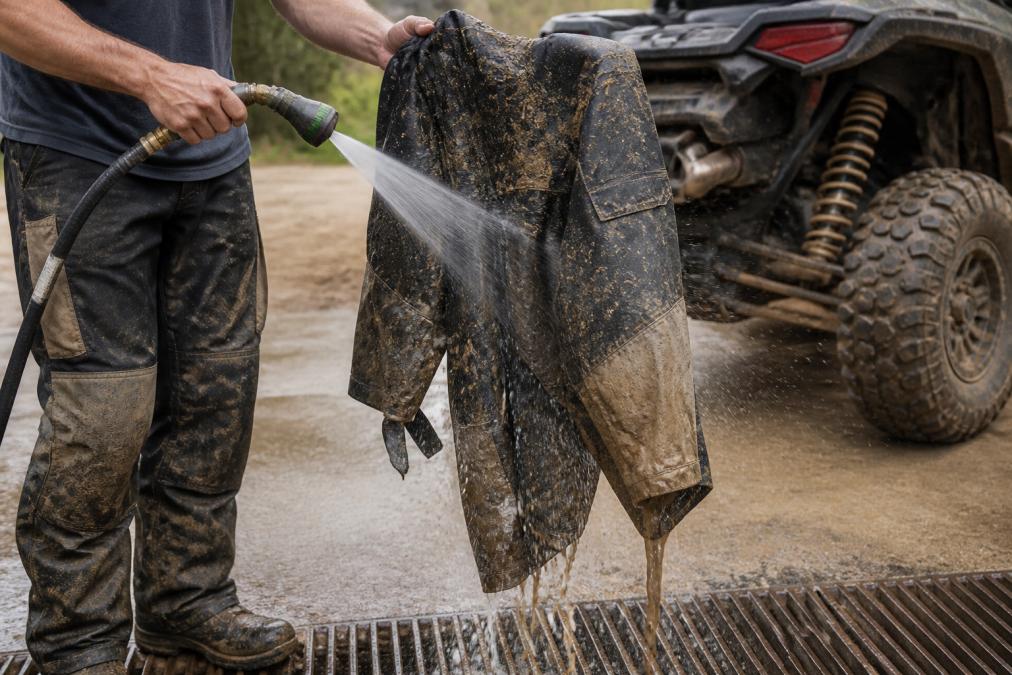
Start by rinsing immediately after your ride. Dried mud is harder to remove and can damage fabric if you scrub aggressively. Use a hose to spray away loose mud, working from top to bottom. Don't use high pressure, a gentle spray is enough. For stubborn caked-on mud, let the gear soak in cool water for 15-20 minutes before rinsing again.
Machine washing works fine for heavyweight tees. Use cold water and a gentle cycle. Avoid bleach, which breaks down cotton fibers and causes premature fading. Mild detergent is all you need. Skip fabric softener, it coats the fibers and reduces breathability and water resistance.
Drying matters. Air dry whenever possible. Heat from the dryer accelerates fabric degradation and can set stains permanently. Hang your gear. If you must use a dryer, use the lowest heat setting.
Every 5-10 washes, retreat water-resistant gear with a DWR product. This restores the water-beading properties and extends the life of your apparel significantly.
Layering and Fit: Building a Durable Mud Riding Setup
Layering strategy determines whether you stay comfortable across temperature swings and changing conditions. Proper fit ensures your layers work together instead of bunching or restricting movement. This is where most riders struggle: standard sizing assumes you're wearing the shirt alone, not over a base layer, and the fit falls apart when you add insulation.
Understanding Layering Fit for Diverse Body Types
When you layer a base layer under a mid-layer under an outer shell, each piece needs to be cut and sized differently to prevent bunching at the shoulders, elbows, and torso. This is the core problem with off-the-rack gear: it's designed for a single-layer fit.
Start with a breathable base layer. The base layer should fit snugly, not tight, but close enough that it doesn't shift during movement. A base layer that's too loose will bunch under your mid-layer and create pressure points at the shoulders. A base layer that's too tight restricts breathing and causes chafing. For riders with broader shoulders or larger frames, look for base layers with articulated shoulder panels that allow arm movement without fabric pulling across the back.
The mid-layer (your heavyweight tee) needs to be sized one size up from your base layer. If you wear a Medium base layer, move to a Large mid-layer. This creates room for the base layer to sit underneath without compressing. However, "one size up" assumes standard proportions. Riders with longer torsos need extended-length mid-layers to prevent shirt ride-up when reaching or climbing. Riders with shorter torsos or broader chests need mid-layers cut with more chest room and less length to prevent excess fabric at the waist.
For cold-weather mud riding, add a water-resistant outer layer. The outer layer should be loose enough to move freely over your base and mid layers but fitted enough to stay in place during active movement. Look for articulated panels at the shoulders and elbows, these allow your arms to move naturally without fabric bunching. The outer layer should be sized 1-2 sizes larger than your mid-layer to accommodate the bulk of two layers underneath without compression.
Fit Variations by Body Type
Riders with longer torsos need extended length on both base and mid-layers to prevent shirt ride-up. Standard sizing often assumes a 1:1 ratio of torso length to arm length, which doesn't account for riders with proportionally longer torsos. Extended-length gear (typically 2-3 inches longer than standard) keeps coverage consistent when you're reaching for handholds or climbing obstacles.
Riders with bigger frames need chest room without excess fabric at the waist. A shirt cut with a straight taper from shoulder to hem will bunch at the sides and restrict arm movement.
The Mobility Test
- Reach both arms overhead and behind your head, fabric should not pull or bunch at the shoulders or lower back
- Rotate your torso left and right, no restriction at the sides or ribs
- Crouch into a climbing position, no fabric bunching at the knees or hips
- Reach down to touch your toes, no shirt ride-up at the lower back
Layering for Temperature Transitions
Frequently Asked Questions
What makes durable clothing for mud riding different from regular outdoor apparel?
Durable clothing for mud riding uses abrasion-resistant, heavyweight fabrics with reinforced seams and sealed construction to withstand constant friction against rocks, brush, and rough terrain. Standard outdoor wear lacks the tightly knit surface and single-needle stitching that prevents tears and holds up through repeated washing. The fabric weight, typically 6.5 oz/yd² or higher, provides the density needed to resist punctures and maintain shape after exposure to mud, water, and intense activity.
Why is heavyweight fabric preferred for trail riding?
Heavyweight fabrics, usually 6.5 oz/yd² or more, deliver superior durability because the tighter knit resists snagging and abrasion from sharp branches and rocky terrain. The extra weight also improves printability for custom designs and maintains structural integrity through repeated mud exposure and washing cycles. Lighter fabrics pill, tear, and fade faster under the same conditions, forcing you to replace gear more often.
Should I prioritize waterproof or breathable gear for mud riding?
Water-resistant gear is typically better for mud riding than fully waterproof apparel because it sheds surface moisture while allowing ventilation, preventing sweat buildup during intense activity. Fully waterproof materials trap heat and moisture inside, making you uncomfortable on longer rides. Water-resistant fabrics with moisture-wicking base layers underneath give you protection without sacrificing breathability during active trail work.
How often should I wash heavyweight off-road gear to keep it durable?
Rinse mud-caked gear immediately after riding to prevent dirt from embedding into fibers and damaging the fabric. Do a full wash within 24 hours using cold water and mild detergent, then air-dry flat or hang to prevent shrinkage. Avoid high heat in the dryer, which breaks down fabric fibers. Proper post-ride care extends the life of heavyweight tees.