

Table of Contents
- Why Premium Shirts for Tall Men Are Worth the Investment
- How to Measure Sleeve Length for Tall Men (and Get It Right Every Time)
- Premium Heavyweight Tees for Tall Men: What Separates the Best from the Rest
- Tall Men's Dress Shirt Fit Guide: Collar, Cuff, and Torso Length
- Big vs. Tall Sizing: What Tall Men Need to Know Before Buying
- The Trail Explorer Picks: Premium Shirts Built for Tall Frames
- Fabric, Durability, and Shrinkage: What Holds Up on the Trail
- Tailoring and Alterations for Tall Men: When to Adjust and When to Buy New
- Frequently Asked Questions
Last Updated: September 16, 2026
Why Premium Shirts for Tall Men Are Worth the Investment
If you stand above 6'2", you know the drill: sleeves that stop at your forearms, hems that ride up when you reach, and a torso that turns every shirt into a crop top after one wash. Premium shirts for tall men solve a problem mass-market apparel ignores. At The Trail Explorer, we build heavyweight tees with a structured fit because off-road riders come in every height.

How to Measure Sleeve Length for Tall Men (and Get It Right Every Time)
Measuring sleeve length for tall men is the step most shoppers skip, and the reason so many shirts get returned. A proper measurement runs from the center back of your neck, across the shoulder point, down to where you want the sleeve to end. Use a flexible tape and have someone help, measuring your own arm introduces error.
The Three Measurements That Matter Most
Three numbers decide whether a tall shirt fits: sleeve length, torso length, and shoulder width. Sleeve length keeps your wrists covered when you reach; torso length keeps the hem in place when you bend or climb; shoulder width controls how the shirt sits without pulling at the chest.
- Sleeve length: center back neck to wrist bone
- Torso length: high point of shoulder to your preferred hem
- Shoulder width: seam to seam across the back
CDC anthropometric reference data for body measurements
Premium Heavyweight Tees for Tall Men: What Separates the Best from the Rest
Fabric weight is the first filter. Premium heavyweight tees for tall men typically land in the 6 to 7 oz/yd² range, giving the cotton enough body to hold its shape instead of clinging. The Trail Explorer's flagship tee uses 100% combed ring-spun cotton at 6.5 oz/yd², side-seamed.
Cotton Incorporated technical guide to ring-spun cotton
Tall Men's Dress Shirt Fit Guide: Collar, Cuff, and Torso Length
A tall men's dress shirt fit guide comes down to three checkpoints: the collar sits snug without choking, the cuff reaches the base of your thumb with your arm at rest, and the torso stays tucked when you raise your arms. If any one fails, the shirt needs a different size or a tailor.
| Fit Checkpoint | What to Measure | Target for Tall Frames |
|---|---|---|
| Collar | Around the neck | Snug, one finger of room |
| Cuff | Wrist to thumb base | Reaches the thumb joint |
| Torso | Shoulder to hem | Stays tucked when arms rise |
| Shoulder | Seam to seam | Matches your shoulder width |
Big vs. Tall Sizing: What Tall Men Need to Know Before Buying
Big and tall sizing is not one category; it is two separate grading systems, and confusing them is the most common reason a tall man ends up with a shirt that fits the neck but not the body. Big sizing adds circumference, chest, waist, and shoulders, for larger frames. Tall sizing adds vertical length in the torso and sleeves without much width.
How the Two Systems Actually Differ in the Size Chart
The tell is in the numbers, not the label. Compare a brand's Large and X-Large against its Large Tall and X-Large Tall:
- A big size step typically adds 2 to 3 inches of chest circumference and 1 to 2 inches of body length.
- A tall size step typically adds 1.5 to 2 inches of body length and 1 to 1.5 inches of sleeve length, with chest circumference held close to the base size.
- A true big and tall size adds both, which is why it is usually graded separately rather than folded into either line.
Body Type Specific Styling: Tall/Slim vs. Big/Tall
Most fit guides treat "tall" as one body. It is not, and the styling advice diverges sharply.
-
Slim or tailored cuts with a defined waist taper, so the shirt follows the torso instead of draping off the shoulders.
-
Side-seamed construction, which keeps the shirt from twisting and preserves the taper through washes.
-
Vertical details, plackets, narrow stripes, long point collars, that work with a long frame rather than chopping it.
-
A hem that hits mid-fly, so the shirt can be worn untucked without looking cropped.
-
Extended sizing that runs to 3XL or 4XL with proportionally longer bodies, not just wider ones.
-
A fuller cut through the chest and armhole so the shirt does not strain when you reach or sit.
-
Reinforced side seams and a heavier fabric weight, since a wide torso puts more lateral stress on the garment.
-
Straight-hem or tunic-length options that stay tucked through movement.
When Big and Tall Overlap
Some men need extra length and extra width together. Look for extended sizing that scales both dimensions proportionally, a 4XL that adds width and length in step, not one that adds width and leaves the hem where the Large ended. The Trail Explorer's heavyweight tee runs from S to 4XL with length that scales alongside width, so a 4XL is genuinely longer, not just broader.
A Quick Decision Check
- Long torso, average width: tall sizing, slim or tailored cut.
- Average torso, larger frame: big sizing, fuller cut.
- Long torso and larger frame: big and tall sizing, extended grading.
- Long torso, narrow shoulders: tall sizing with a shoulder seam that lands on your actual shoulder point, not past it.
Check the size chart before you buy, and compare the listed body length and chest circumference to a shirt you already own. That comparison prevents most returns.
The Trail Explorer Picks: Premium Shirts Built for Tall Frames
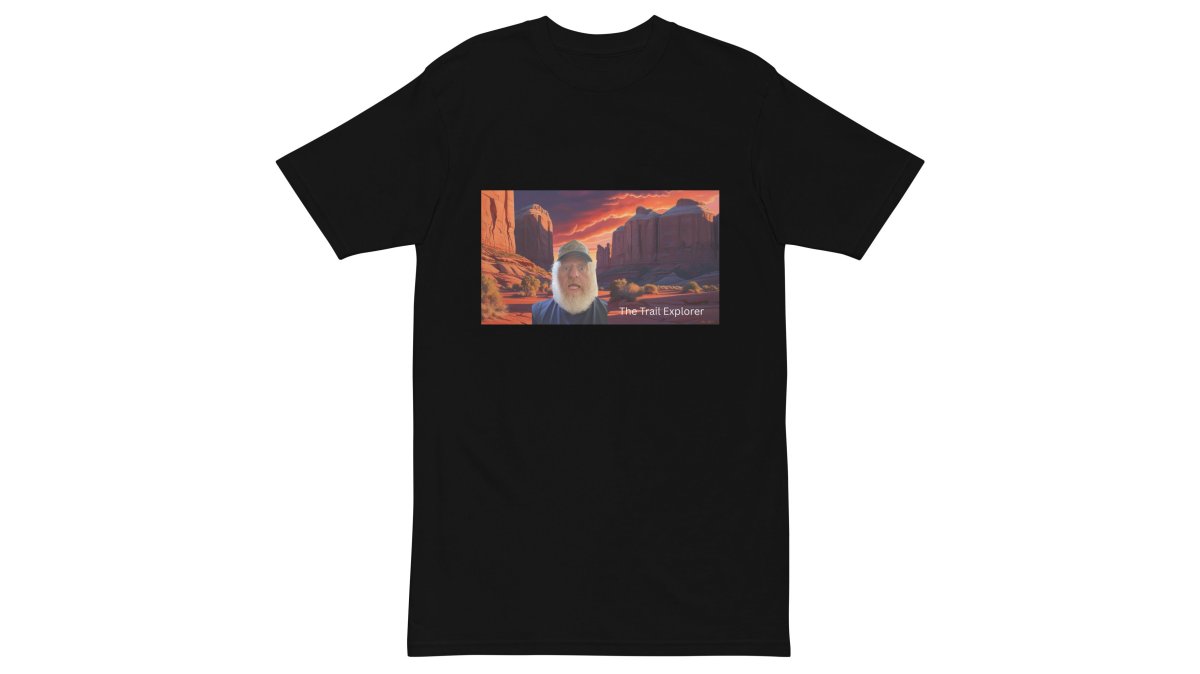
Our top pick for tall riders is the Men's premium heavyweight tee The Trail Explorer at $35.00. The 6.5 oz/yd² combed ring-spun cotton gives it the structure a long torso needs, and the regular fit with side-seamed construction keeps it from twisting after a wash.
| Shirt | Price | Fabric Weight | Best For |
|---|---|---|---|
| The Trail Explorer Heavyweight Tee | $35.00 | 6.5 oz/yd² | Everyday trail wear |
| Make Rock Crawling Great Again Tee | $38.00 | 5.5 oz/yd² | Bold graphic, lighter feel |
| Take the Trail Less Traveled Long Sleeve | $35.00 | 6.5 oz/yd² | Cooler weather, layering |
Fabric, Durability, and Shrinkage: What Holds Up on the Trail
Cotton shrinkage is real, and tall men feel it first because there is less hem to spare. A shirt that loses an inch of body length is a minor annoyance on an average frame and a dealbreaker on a long torso. Understanding why cotton moves, and which construction choices limit it, separates a shirt that survives a season from one that survives five.
Why Cotton Shrinks, and Why Combed Ring-Spun Shrinks Less
Cotton fiber is a twisted, absorbent structure. When it meets heat and moisture, the fibers relax and the yarn contracts, showing up as length and width loss. How much it moves depends on how the yarn was made.
- Standard carded cotton retains short fibers, called noils, that tangle and mat during washing. Those tangles drive most of the shrinkage and the pilling.
- Combed cotton runs the fiber through a combing process that removes short fibers and impurities before spinning. Fewer short fibers means less tangling, less pilling, and less length loss over repeated washes.
- Ring-spun cotton spins the fibers into a tighter, smoother yarn, producing a stronger fabric with a softer hand. Combined with combing, it is the construction most premium tall tees rely on.
Fabric Weight and What It Does for a Tall Frame
Fabric weight is measured in ounces per square yard (oz/yd²) and is the first filter for a tall-friendly shirt.
- Under 5 oz/yd²: light and breathable, but thin enough to cling and to show every contour. Tall frames stress these shirts at the shoulders and hem.
- 5 to 6 oz/yd²: a middle ground. Comfortable, but often lacks the body to hold a straight hem on a long torso.
- 6 to 7 oz/yd²: the premium heavyweight range. Enough structure to drape instead of cling, and enough mass to resist abrasion and hold its shape through washes.
The Trail Explorer's flagship tee sits at 6.5 oz/yd².
Seam Construction: Where Tall Shirts Fail First
A tall frame loads the garment at three points: the shoulder seam, the side seam, and the hem. Construction quality there decides how long the shirt lasts.
- Side-seamed construction sews the shirt from a tube rather than a flat panel, which prevents the twisting that plagues cheaper tees after a few washes.
- Single-needle edge stitching reinforces the seams where the fabric is under the most tension.
- A 1×1 rib collar, often with a small amount of Lycra, holds its shape at the neck instead of stretching out.
- Double-stitched hems resist the fraying that starts at the bottom of a long torso.
Care That Preserves Length
Shrinkage is partly a care problem. A few habits keep a heavyweight tee close to its original measurements:
- Wash cold. Heat is the main driver of fiber contraction.
- Dry low or line dry. High dryer heat does the most damage to length.
- Wash inside out to reduce surface abrasion and pilling.
- Skip the heavy detergent and fabric softener, which can coat the fiber and reduce breathability.
American Cleaning Institute fabric care guidance
Sustainable and Ethical Sourcing: The Question Most Guides Skip
Few fit guides address where the cotton comes from or how the shirt was made, and that is a growing priority for buyers. A few things worth checking:
- Fiber origin and certification. Look for cotton grown under recognized sustainability programs, which address water use, soil health, and worker conditions.
- Dyeing and finishing. Lower-impact dye processes reduce water and chemical use, and they are increasingly disclosed on product pages.
- Manufacturing transparency. Brands that name their factories or publish a supply chain statement are easier to hold accountable than those that do not.
- Durability as sustainability. The most sustainable shirt is the one you keep wearing.
Tailoring and Alterations for Tall Men: When to Adjust and When to Buy New
Tailoring is the tall man's secret weapon, but only when the shirt is close to right. If the shoulders and chest fit and only the sleeves or hem are off, a tailor can fix it for a modest fee. If the shoulders pull or the collar gaps, no alteration saves it; buy a different size or cut.
- Worth altering: sleeve length, hem length, waist taper
- Not worth altering: shoulder width, collar size, overall torso length
- Buy new instead: when shoulders or collar do not fit
Frequently Asked Questions
What defines a premium shirt for tall men?
A premium shirt for tall men has longer sleeves and reinforced construction. Look for fabric weight of at least 6.5 oz/yd² for durability, side-seamed construction, and a fit designed for longer frames. The Trail Explorer's heavyweight tees, for example, run from 29.5 to 35.5 inches in length across sizes S through 4XL, giving tall men room without sizing up.
How do I measure for a tall-sized shirt?
Measure your sleeve length from the center back of your neck, across your shoulder, and down to your wrist bone. For torso length, measure from the base of your neck to where you want the hem to sit. Compare those numbers against the brand's size chart. If your sleeve measurement exceeds the chart by more than an inch, you need a tall-specific cut rather than a standard size.
Are tall sizes the same as big and tall?
No. Big and tall combines two different fits. Big sizes add width through the chest and waist. Tall sizes add length in the torso and sleeves without extra width. A 6-foot-4 man who weighs 190 pounds needs tall sizing, not big and tall. Buying big and tall when you only need tall leaves you swimming in fabric through the midsection while the sleeves may still fall short.
What fabrics hold up best for premium heavyweight tees for tall men?
Combed ring-spun cotton at 6.5 oz/yd² or higher resists shrinkage and holds its shape after repeated washing. Blends with 40% polyester, like charcoal heather options, add durability without sacrificing softness. Avoid lightweight fabrics under 5 oz/yd², which stretch out at the hem and lose shape faster on a tall frame. Soft-washed fabrics reduce the risk of length loss after the first wash.
How should a premium shirt fit on a tall frame?
The shoulder seam should sit at the edge of your shoulder bone, not droop past it. Sleeves should end at the wrist bone when your arms are at your sides. The hem should cover your belt line and reach mid-hip, roughly 3 to 4 inches below your waistband. If the shirt pulls across the chest or the hem rises when you reach overhead, the fit is wrong for your proportions.
Tall frames expose every shortcut in a shirt, from a hem that rides up to a collar that loses shape after two washes. The Trail Explorer builds premium shirts for tall men with 6.5 oz/yd² combed ring-spun cotton, side-seamed construction, and reinforced collars, plus extended sizing that adds length where you need it. Explore the heavyweight tee collection and subscribe to our emails for new trail-ready drops.