

Table of Contents
- Why Look for a CombatOffroad Alternative?
- What Defines a Premium Heavyweight Tee for the Trail?
- The Trail Explorer: A Direct CombatOffroad Alternative for Premium Tees
-
How to Choose Among the Best Off-Road Clothing Brands
- Step 1: Match Fabric Weight to Your Riding Season
- Step 2: Verify the Fit Against Your Actual Measurements
- Step 3: Check the Collar and Seam Construction
- Step 4: Evaluate the Graphic Application, Not Just the Design
- Step 5: Read Reviews for Fit and Shrinkage Complaints
- Common Mistakes to Avoid
- Quick Reference: What to Look For in a Spec Sheet
- Fabric Performance: Testing Heavyweight Off-Road T-Shirts
- Care and Maintenance for Shrink-Resistant Graphics
- The Verdict: Which Premium Tee Fits Your Rig?
- Frequently Asked Questions
Last Updated: September 5, 2026
Why Look for a CombatOffroad Alternative?
Most off-road apparel brands focus on loud graphics and thin cotton that fails after a few rocky trails. A CombatOffroad alternative for premium tees should prioritize fabric weight, seam construction, and designs that speak to your rig and your miles.
The search usually starts after a season of washing, when collars warp, prints crack, and the "heavyweight" fabric proves to be a marketing term. A true premium tee starts with 6.5 oz/yd² ring-spun cotton, side-seamed construction, and a reinforced collar (fabriclink.com).
Below, we break down what separates trail-worthy tees from closet filler, then show options that deliver on durability, comfort, and off-road character.
What Defines a Premium Heavyweight Tee for the Trail?
A premium heavyweight tee is built with dense, combed ring-spun cotton that resists abrasion, holds its shape through repeated washes, and provides thermal regulation. Fabric weight is the first number to check: 6.5 oz/yd² (220 g/m²) offers durability for rugged terrain, while lighter 5.5 oz/yd² (180 g/m²) shirts trade toughness for breathability.

Material composition matters too. A 100% combed ring-spun cotton blend feels soft but stands up to branches, seat belts, and gear straps (cottoninc.com). Some colorways, like Charcoal Heather, mix in 40% polyester for stretch and moisture-wicking. Look for 20 singles yarn, which resists pilling.
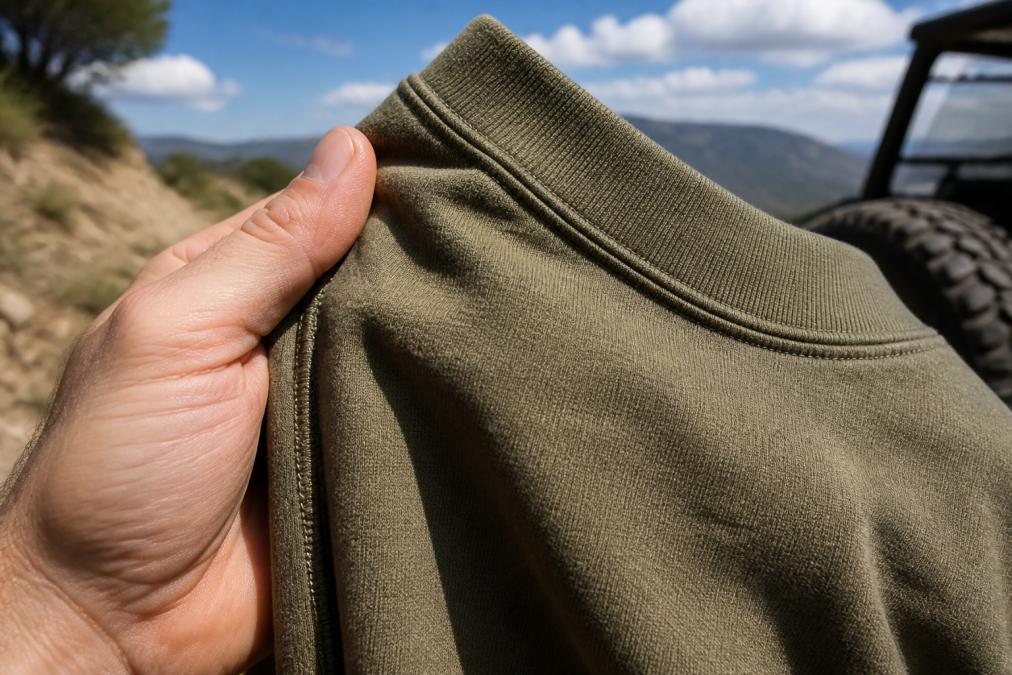
Construction details separate technical gear from basic merchandise: side-seamed bodies prevent twisting, a 1x1 ribbed collar keeps its shape, and single-needle edge stitching at 7/8 inch reinforces high-stress seams.
The Trail Explorer: A Direct CombatOffroad Alternative for Premium Tees
For riders seeking a combatoffroad alternative that matches big-name durability with designs rooted in trail culture, The Trail Explorer delivers. Unlike generic brands that slap a mountain silhouette on a standard tee, every graphic ties to rock crawling, side-by-side riding, and the machines you wheel.
Men’s Premium Heavyweight Tee (The Trail Explorer)
Our flagship tee hits the specs that matter for trail abuse. At $35.00, it brings 100% combed ring-spun cotton in a 6.5 oz/yd² weight with 20 singles construction. The regular fit accommodates bigger frames without looking baggy, and the side-seamed body prevents twisting.
The 1x1 rib collar with single-needle edge stitching won't stretch out after hot washes. Sizing runs true from S through 4XL.
Men’s premium heavyweight tee The Trail Explorer
Cotton Heritage MC1082: A Lighter, Everyday Option
For warmer months or casual wear, the Cotton Heritage MC1082 at $38.00 offers a lighter 5.5 oz/yd² build that prioritizes breathability. The 100% combed ring-spun cotton feels broken-in from the first wear, with drop shoulder sleeves for a relaxed silhouette.
This tee features a tear-away tag and a reinforced ribbed collar.
Cotton Heritage MC1082 I Men's Premium Short Sleeve Tee

How to Choose Among the Best Off-Road Clothing Brands
Choosing the right off-road tee comes down to matching construction to your riding style and body type. The best brands publish detailed spec sheets, but you need to know which numbers matter. Here is the framework we use.
Step 1: Match Fabric Weight to Your Riding Season
Fabric weight is the biggest differentiator between a summer shirt and a year-round workhorse. A 6.5 oz/yd² (220 g/m²) tee is the sweet spot for rock crawling and cooler mornings because the denser weave resists abrasion from seat belts, branches, and tool belts, and drapes better.
A 5.5 oz/yd² (180 g/m²) tee is better for desert heat or slow technical trails where you're outside the cab more. It breathes better but shows wear faster against rocks. If you ride year-round, own one of each weight.
Step 2: Verify the Fit Against Your Actual Measurements
Off-road brands are notorious for inconsistent sizing. Before you buy, measure a shirt that fits you well and compare it to the brand's size chart. Pay attention to three numbers:
- Chest width (measured 1 inch below the armhole): This determines whether the shirt fits snug or loose. For off-road use, you want at least 2 inches of ease so you can move your arms freely when grabbing the steering wheel or reaching for a strap.
- Body length: A tee that rides up when you raise your arms is useless on the trail. Look for a length that reaches mid-hip on your frame.
- Sleeve opening: This is often overlooked, but a tight sleeve opening will bunch up under a pack strap or push up your forearm when you're working.
Many premium brands, including The Trail Explorer, offer sizes up to 4XL or 5XL with chest measurements that scale proportionally. Avoid brands that only add length as sizes go up, that's a sign of a limited blank.
Step 3: Check the Collar and Seam Construction
A collar that twists or stretches is the first sign of a cheap tee. Look for a 1x1 ribbed collar with single-needle edge stitching, which holds its shape through washing. Side-seamed bodies are another non-negotiable, tubular knit shirts twist over time, making the graphic sit crooked.
Step 4: Evaluate the Graphic Application, Not Just the Design
Screen-printed graphics on combed cotton outlast vinyl transfers, which crack and peel (impressionsmagazine.com). Look for plastisol or water-based inks applied directly to the fabric. Avoid "print-on-demand" services with generic blanks, which often use lower-quality transfers.
Step 5: Read Reviews for Fit and Shrinkage Complaints
Customer reviews are the most honest source of sizing information. If multiple reviewers say the shirt runs small or shrinks, trust that over the brand's chart. Also check whether reviewers mention performance after several washes, a tee that pills or fades by wash ten isn't premium.
Common Mistakes to Avoid
- Buying on the graphic alone: That $25 shirt with the killer skull-and-gears print might use 4.5 oz/yd² fabric that goes translucent after a season of sun. Check the spec sheet first.
- Ignoring the blank source: Many brands print on the same generic blanks you can buy at a craft store. If the brand doesn't list the fabric weight or construction details, assume it's a standard 5.3 oz/yd² tee with a markup.
- Assuming heavier is always better: A 7.5 oz/yd² tee is durable but can feel like wearing a canvas bag in summer. Match the weight to your climate and riding style.
Quick Reference: What to Look For in a Spec Sheet
| Specification | What It Means | Why It Matters |
|---|---|---|
| 6.5 oz/yd² (220 g/m²) | Heavyweight fabric | Abrasion resistance, drapes well, blocks wind |
| 5.5 oz/yd² (180 g/m²) | Midweight fabric | Breathable, good for summer, less durable |
| 100% combed ring-spun cotton | Long-staple fibers, soft feel | Resists pilling, holds color better than carded cotton |
| 20 singles yarn | Finer, stronger thread | Less likely to pill or develop thin spots |
| Side-seamed body | Panels sewn together | Prevents twisting, maintains shape |
| 1x1 ribbed collar | Stretchy, dense collar knit | Holds shape, doesn't stretch out |
| Single-needle stitching | One needle seam at 7/8 inch | Reinforces high-stress seams |
A brand that lists these specifications is confident in its product. A brand that only shows lifestyle photos is selling you a graphic, not a garment. The best off-road clothing brands treat their tees as technical gear, and the spec sheet is the proof.
Fabric Performance: Testing Heavyweight Off-Road T-Shirts
Most off-road apparel marketing stops at "heavyweight cotton." But premium tees live or die on real trail performance. Since no standardized industry test exists, we developed a practical stress test protocol any rider can replicate at home.
Abrasion Resistance: The Seat Belt Test
The most common failure point on an off-road tee isn't the trail, it's the seat belt. To test abrasion resistance, rub the fabric against a rough surface in a circular motion for 30 seconds. A quality 6.5 oz/yd² combed ring-spun cotton will show minimal fuzz; a lighter 4.5 oz/yd² tee will pill almost immediately.
For a more controlled test, use a standard denim-on-denim rub test: rub the fabric against a piece of raw denim 50 times. Heavyweight cotton (6.5 oz/yd²) should show no visible wear. Midweight (5.5 oz/yd²) will show slight surface smoothing. Anything lighter will show visible abrasion marks.
Moisture-Wicking: The Sweat Spot Test
Cotton absorbs sweat and holds it against your skin, fine for short rides, but it leads to chafing on long days. Heather colorways that blend 40% polyester with 60% cotton change the equation: the polyester pulls moisture away from the skin and spreads it across the surface to evaporate faster.
To test this at home, put a drop of water on the fabric and time how long it takes to absorb. Pure cotton absorbs instantly. A cotton-poly blend will bead up slightly and take a few seconds longer. That beading is actually the moisture-wicking mechanism working, the water is being held on the surface rather than soaking straight through to your skin.
Shrinkage: The Wash Test
Pre-shrunk cotton still shrinks, it just shrinks less. Combed ring-spun cotton that's been through sanforization (a controlled shrinking treatment) will shrink less than 3% after the first wash. Unprocessed cotton can shrink 5-7%.
To test shrinkage, measure the chest width and body length of a new tee, wash it in cold water, and dry it on low heat. Measure again. A premium tee should lose no more than half an inch in chest width and a quarter inch in length. If it shrinks more than that, the brand is cutting corners on pre-shrinking.
Colorfastness: The Fade Test
Off-road tees take a beating from sun, sweat, and washing. Dark colors, especially black, charcoal, and navy, are most prone to fading. Fiber-reactive dyes bond with the fibers and resist fading; pigment dyes sit on the surface and wash out.
A simple test: dampen a white cloth and rub it against the colored fabric. If significant color transfers to the white cloth, the dye isn't properly set. Also check whether the brand recommends washing in cold water, that's usually a sign they're using higher-quality dyes that don't require hot water to activate.
Seam Integrity: The Pull Test
Seams are the structural weak point of any garment. Side-seamed construction is inherently stronger than tubular knit, but stitching quality matters too. Look for single-needle stitching at 7/8 inch, this creates a secure seam that won't unravel.
To test seam integrity, grab the fabric on either side of a seam and pull firmly in opposite directions. A quality seam will hold without gaping or stretching. A weak seam will show visible gaps between the stitches. This is especially important at the shoulder seams, which take the most stress when you're reaching for the steering wheel or lifting gear.
Real-World Performance Context
Lab tests only tell part of the story. Here's what we've observed from riders in actual off-road conditions:
- Rock crawling: The 6.5 oz/yd² fabric holds up to constant contact with roll bars, seat belts, and rock surfaces. Riders report minimal pilling after a full season.
- Desert riding: The same heavyweight fabric can feel too warm in direct sun. Riders in 100°F+ conditions prefer the 5.5 oz/yd² option for breathability.
- Hunting and camping: The heavyweight tee works well as a base layer under a flannel or softshell. The dense cotton traps heat without the scratchiness of synthetic thermal layers.
- Everyday wear: Both weights hold their shape through repeated washing, but the heavyweight option develops a nice, broken-in feel over time without losing its structure.
The Bottom Line on Fabric Testing
A premium off-road tee isn't just a shirt with a cool graphic, it's technical gear. Fabric weight, construction, and dye quality determine whether it survives a season or ends up as a garage rag. When a brand lists specs like 6.5 oz/yd², 20 singles yarn, and side-seamed construction, that's a promise it was engineered for the trail.
Care and Maintenance for Shrink-Resistant Graphics
Proper care keeps a premium tee looking sharp for years. Wash heavyweight off-road t-shirts inside out in cold water to protect the print from friction. Use a mild detergent without bleach or fabric softener, which breaks down cotton fibers.
For drying, low heat or line drying is best. High heat is the primary cause of shrinkage in collars and hems, even with pre-shrunk cotton. The 6.5 oz/yd² fabric handles machine drying better than lighter weights, but graphics crack faster with high-heat cycles.
When storing, fold tees rather than hanging them. Hanging stretches shoulder seams and creates creases at the collar. Folding also prevents prints from sticking to adjacent fabrics in humid conditions.
The Verdict: Which Premium Tee Fits Your Rig?
Choosing the right combatoffroad alternative comes down to how and where you ride. For hardcore trail use, rock crawling, and hunting trips, the Men's Premium Heavyweight Tee from The Trail Explorer at $35.00 is the clear winner.
For warmer climates or a lighter feel, the Cotton Heritage MC1082 at $38.00 delivers breathability and a relaxed fit without sacrificing print quality. Riders wanting machine-specific designs should check the Kawasaki KRX and Old Man graphics, both on the same heavyweight platform.
The bottom line: a true premium tee is an investment in fabric and construction, not just a logo. The Trail Explorer builds shirts that survive abuse and still look good at the trailhead. That's the difference between apparel and gear.
Frequently Asked Questions
What makes a premium heavyweight tee better for off-roading than a standard t-shirt?
A premium heavyweight tee uses denser fabric, typically 6.5 oz/yd² or heavier, which provides better abrasion resistance against seat belts, harnesses, and trail gear. The combed ring-spun cotton is softer than standard cotton but more durable, and the side-seamed construction prevents twisting after washes. These features matter on the trail where a cheap shirt can snag or tear on equipment.
Is a cotton-polyester blend or 100% cotton better for a CombatOffroad alternative?
For a combat shirt alternative, a cotton-polyester blend offers faster drying and better moisture-wicking. However, for off-road use, a 100% combed ring-spun cotton tee at 6.5 oz/yd² provides superior breathability and comfort in dusty conditions. The Trail Explorer uses this heavyweight cotton for most designs, with polyester added only in heather colors to maintain colorfastness.
How does The Trail Explorer compare to other best off-road clothing brands?
The Trail Explorer focuses exclusively on the off-road community with designs that speak to rock crawling and trail exploration. Unlike generic outdoor brands, each tee is made to order, reducing overproduction. The 6.5 oz/yd² fabric is heavier than typical 5 oz shirts from mass-market brands, giving you better durability.
Will a heavyweight off-road t-shirt shrink after washing?
The Trail Explorer's heavyweight tees are made from combed ring-spun cotton, which is pre-shrunk during the manufacturing process. To maintain the fit and protect screen-printed graphics, wash in cold water and tumble dry on low. The side-seamed construction also helps the shirt keep its shape. Following this care routine prevents shrinkage and keeps the design looking sharp.
Finding a durable, well-fitting tee that expresses your off-road passion shouldn't require settling for generic outdoor brands or flashy competitors. The Trail Explorer crafts premium heavyweight tees with reinforced seams, combed ring-spun cotton, and designs rooted in rock crawling culture. Explore the full collection and subscribe to our emails for new trail-inspired drops that hold up to real miles.