

Table of Contents
- Heavyweight vs Lightweight Trail Tees: Quick Comparison
- Understanding Fabric Weight: GSM Weight Guide for Outdoor Shirts
- Durable Heavyweight T-Shirts for Off-Roading: Strength and Longevity
- Breathable Trail Shirts for Summer: Lightweight Performance
- Fit, Drape, and Silhouette: How Weight Affects Your Look
- Which Trail Tee Should You Choose?
- Conclusion
- Frequently Asked Questions
Last Updated: September 3, 2026
Heavyweight vs Lightweight Trail Tees: Quick Comparison
The weight of your trail shirt matters more than most realize. Heavyweight vs lightweight trail tees affects durability, comfort, breathability, and performance in the field. At The Trail Explorer, we understand what off-road enthusiasts need: heavyweight trail tees (6+ oz/yd²) excel at durability for serious rock crawling, while lightweight options (4-5 oz/yd²) prioritize breathability for summer riding. Most serious trail riders own both and rotate based on conditions.
| Feature | Heavyweight (6+ oz/yd²) | Lightweight (4-5 oz/yd²) | Best For |
|---|---|---|---|
| Durability | Superior, resists abrasion | Good, adequate for moderate use | Rock crawling, technical terrain |
| Breathability | Moderate | Excellent | Summer, high-intensity effort |
| Weight | Heavier, structured feel | Light, minimal | All-day comfort, layering |
| Thermal Regulation | Better insulation | Minimal warmth | Cool weather, layering |
| Drape | Stiffer, more structured | Fluid, relaxed | Casual appearance |
| Cost | Higher | Lower | Budget-conscious riders |
| Shrinkage Risk | Moderate with care | Lower with pre-shrunk | Long-term durability |
Understanding Fabric Weight: GSM Weight Guide for Outdoor Shirts
Fabric weight is measured in grams per square meter (GSM) or ounces per square yard (oz/yd²). A 142 g/m² (4.2 oz/yd²) shirt feels completely different from a 220 g/m² (6.5 oz/yd²) shirt. Heavier fabric has more fibers working together to resist tearing, snagging, and UV degradation, though it allows less airflow (peer-reviewed research).
Lightweight (142-170 g/m² / 4.2-5 oz/yd²): Designed for high-output activities where sweat management matters more than abrasion resistance. The Unisex t-shirt from The Trail Explorer sits at 142 g/m², ideal for summer riding. The fabric has a softer hand-feel and drapes naturally, but thinner material means less protection against sharp rocks.
Midweight (180-200 g/m² / 5.3-5.9 oz/yd²): The sweet spot for many trail riders. The Cotton Heritage MC1082 at 180 g/m² (5.5 oz/yd²) offers durability for moderate abrasion while maintaining reasonable breathability.
Heavyweight (220+ g/m² / 6.5+ oz/yd²): Where serious durability lives. The Men's Premium Heavyweight Tee hits 220 g/m² (6.5 oz/yd²), and the Utah Desert Edition comes in at 203.4 g/m² (6.0 oz/yd²). Densely woven fibers resist pilling, hold shape through repeated washing, and provide better protection against sharp edges. Fabric density directly correlates with tensile strength, a heavier shirt won't tear as easily when catching on rock outcrops.

Durable Heavyweight T-Shirts for Off-Roading: Strength and Longevity
Heavyweight trail tees are engineered for punishment. When your shirt might catch on sharp rocks or brush against rough surfaces, heavier fabric is your insurance policy.
Durability and Structural Integrity
The Men's Premium Heavyweight Tee uses 100% combed ring-spun cotton (with some colorways blending 40% polyester). Combed cotton removes shorter fibers, leaving only longer fibers that create a smoother, more durable surface (peer-reviewed research). Ring-spun construction twists those fibers tightly, increasing tensile strength and reducing pilling (peer-reviewed research).
In real-world use, combed ring-spun cotton resists snagging better than cheaper alternatives. The fabric won't pill after repeated washing, and color holds longer because the denser weave protects dyes from UV exposure. Heavyweight fabrics maintain their shape through countless wash cycles, the collar won't stretch and sleeves won't sag the way lightweight options can.
Proper care extends durability: wash in cold water and air-dry. Heat from the dryer causes minor shrinkage and accelerates wear on fibers.
Thermal Regulation and Layering
Heavyweight shirts excel at layering systems. The denser weave traps a thin layer of warm air against your skin, providing comfort during cool-weather rides. More importantly, heavyweight fabrics work as excellent base or mid-layers without bunching or shifting. The Men's Premium Heavyweight Tee at 220 g/m² provides enough structure to layer under a jacket while breathing well enough to prevent overheating.
For three-season riding, spring, fall, and winter, heavyweight provides the thermal regulation you need without requiring a separate insulating layer.
Breathable Trail Shirts for Summer: Lightweight Performance
Lightweight trail tees prioritize airflow and sweat management. The Unisex t-shirt's 4.2 oz/yd² weight moves air dramatically better than heavyweight equivalents.

Airflow and Moisture-Wicking
Loosely woven lightweight fabric allows air to pass through easily. You'll feel no clammy feeling against your chest during intense effort. Combed and ring-spun cotton construction still provides decent durability for moderate trail work, with the priority on breathability.
Lightweight fabrics dry faster. When sweat wicks away, it evaporates quicker from thinner material. This cooling effect becomes critical during summer riding when ambient temperatures push you toward overheating. The trade-off is protection: a 142 g/m² shirt won't resist abrasion like a 220 g/m² shirt will. For summer trail riding where you're mostly dealing with sun exposure, dust, and sweat rather than mechanical abrasion, lightweight is the smarter choice.
Seasonal Suitability
Lightweight shirts excel in summer riding, high-altitude climbs, and desert terrain. Spring and fall present a hybrid scenario where midweight options like the Cotton Heritage MC1082 (180 g/m²) handle temperature fluctuations better than either extreme. Winter riding demands heavyweight for thermal regulation.
The seasonal strategy most experienced trail riders use: own both. Rotate lightweight for summer, heavyweight for cooler months. The cost difference is modest, The Trail Explorer's Unisex option runs $24.50 while the Men's Premium Heavyweight is $28.25, making a seasonal rotation economical.
Fit, Drape, and Silhouette: How Weight Affects Your Look
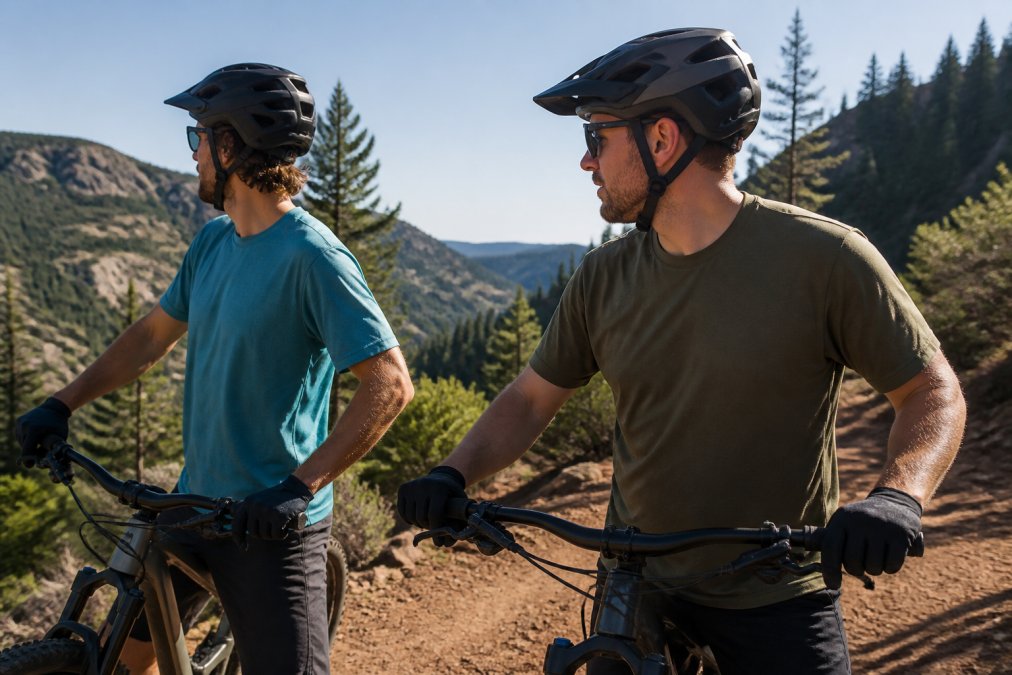
Fabric weight dramatically changes how a shirt looks and feels on your body, affecting both comfort and function.
Heavyweight fabrics create a structured silhouette. The Men's Premium Heavyweight Tee's 220 g/m² weight means the fabric holds its shape and drapes away from your body, working well for layering or if you prefer a cleaner line. The shirt maintains its form through the day with no stretching or sagging.
Lightweight fabrics drape differently. The Unisex t-shirt at 142 g/m² follows your body's contours more closely, offering a relaxed, casual feel with no restriction. The trade-off is that lightweight shirts can stretch slightly over time, particularly at the collar and sleeve openings.
The Utah Desert Edition (203.4 g/m²) occupies middle ground. Its relaxed fit and garment-dyed finish create a broken-in aesthetic from day one. Combined with its moderate weight, you get a shirt that looks intentional without feeling stiff.
Fit consistency matters too. The Men's Premium Heavyweight Tee offers sizes from S through 4XL with generous length increments (29.5" in Small to 35.5" in 4XL), preventing the too-short problem that plagues many offerings.
Which Trail Tee Should You Choose?
The decision comes down to three factors: your primary use case, the season, and your body type.
Choose heavyweight if: You're doing serious rock crawling or technical terrain where abrasion risk is high. You ride primarily in cooler months. You want a shirt that maintains its shape through years of use. You prefer a structured fit. The Men's Premium Heavyweight Tee at $28.25 represents solid value for a 220 g/m² combed ring-spun cotton shirt.
Choose lightweight if: Summer riding is your primary focus. You're managing high-output efforts where sweat management matters. You prioritize comfort and minimal restriction. The Unisex t-shirt at $24.50 delivers excellent breathability and pre-shrunk fabric.
Choose midweight if: You want a single shirt handling multiple seasons reasonably well. You ride varied terrain where durability and breathability both matter. The Cotton Heritage MC1082 at $34.00 provides the balance.

For most trail riders, owning multiple weights is practical. The cost difference is minimal, and rotating based on conditions optimizes both performance and longevity. A year-round enthusiast could pair the lightweight Unisex t-shirt with the Men's Premium Heavyweight for cooler months, adding the midweight Cotton Heritage for spring and fall transitions.
Conclusion
The heavyweight vs lightweight trail tees decision isn't about one being universally better, it's about matching the shirt to your specific conditions and priorities. Heavyweight excels at durability for serious trail work. Lightweight prioritizes breathability for high-output summer riding. Most experienced trail riders own both.
The Trail Explorer's collection covers all the bases. The Men's Premium Heavyweight Tee delivers the durability serious rock crawlers need, while the Unisex lightweight option handles summer riding with excellent breathability. Whether you're building your first trail tee rotation or expanding an existing collection, The Trail Explorer ensures you're getting premium combed ring-spun cotton construction, proper sizing across body types, and designs that capture the spirit of off-road adventure. Get started with The Trail Explorer and build a rotation that matches your riding style.
Frequently Asked Questions
Are heavyweight tees more durable for off-roading?
Yes. Heavyweight tees have higher fabric density and greater tensile strength, which means they resist tearing, pilling, and abrasion better during rock crawling and trail riding. A heavyweight tee at 6.0-6.5 oz/yd² (203-220 g/m²) withstands rough terrain and repeated washing far better than lightweight options at 4.2 oz/yd² (142 g/m²). This durability makes them ideal for serious off-road use where your shirt faces constant contact with rocks, brush, and equipment.
What is GSM and why does it matter for trail apparel?
GSM (grams per square meter) measures fabric weight and density. Higher GSM means thicker, more durable fabric; lower GSM means lighter, more breathable fabric. For trail shirts, GSM directly affects durability, thermal regulation, and breathability. A trail tee at 220 g/m² (heavyweight) offers superior durability and insulation, while 142 g/m² (lightweight) prioritizes airflow and moisture-wicking. Knowing your shirt's GSM helps you match it to your activity, climate, and expected wear.
Should I choose lightweight or heavyweight tees for high-heat trail conditions?
Lightweight tees perform better in high-heat conditions. Their lower fabric density allows greater airflow and faster moisture-wicking, keeping you cooler during intense summer trail rides. Lightweight options at 4.2 oz/yd² (142 g/m²) are designed for breathability and thermal regulation in warm weather. Heavyweight tees trap more heat and are better suited for cooler seasons or layering systems. If you ride in hot conditions, prioritize lightweight construction with quality moisture-wicking fibers.
Do heavyweight tees shrink or fade after washing?
Quality matters. Premium heavyweight tees made from combed ring-spun cotton with pre-shrunk fabric resist shrinkage and fading when cared for properly. The Trail Explorer's premium heavyweight tee at 6.5 oz/yd² (220 g/m²) uses ring-spun cotton construction and reinforced stitching to maintain shape and color through repeated washing. Always follow care instructions: wash in cold water, avoid high heat drying, and turn the shirt inside out to protect graphics and color. Higher-quality construction directly impacts longevity.
This article was written using GrandRanker