

Last Updated: October 24, 2026
Quick Summary
What are common mistakes when off-roading? The most costly is hitting the trail unprepared, skipping vehicle checks, ignoring ground clearance limits, running incorrect tire pressure, driving too fast, and using wrong recovery techniques. Proper preparation, smooth driving technique, and knowing your vehicle's capabilities prevent most off-roading disasters.
- Proper tire inspection reduces roadside failures by up to 40% according to Tire Industry Association guidelines.
- Carry at least two spares, tire plugs, and a portable air compressor since sidewall damage requires full tire replacement.
- Shift into 4L before spinning tires in 4H, as wheel spin digs holes and buries the vehicle.
- Never stand in line with a strap or winch line under tension, as failure creates a whip hazard.
- Stay on marked trails to prevent vegetation damage and erosion that leads to trail closures.
Table of Contents
- Ignoring Vehicle Preparation and Ground Clearance Limits
- Tire Pressure and Damage Prevention Mistakes
- Speed Control and Driving Technique Errors
- Off-Roading Safety Checklist Before You Hit the Trail
- 4H vs. 4L for Mud and Traction Control
- Off-Road Recovery Gear and When Not to Attempt Recovery
- Off-Road Trail Etiquette and Environmental Responsibility
- Gear Up for Your Next Adventure
- Frequently Asked Questions
Ignoring Vehicle Preparation and Ground Clearance Limits
What are common mistakes when off-roading? The first and most costly is hitting the trail unprepared. Many enthusiasts underestimate their vehicles or skip pre-trip checks. Your 4-wheel drive isn't invincible, and neither is your undercarriage.
Ground clearance determines what terrain you can safely traverse. A vehicle with 8 inches of clearance will hang up on obstacles a lifted Jeep clears easily.
Vehicle preparation separates confident drivers from stranded ones. Tire damage prevention starts before you leave home: inspect sidewalls for cracks, check tread depth, and ensure your spare is in good condition. The Tire Industry Association guidelines on tire maintenance emphasize that proper inspection reduces roadside failures by up to 40%.
Short wheelbase vehicles (like most Jeeps) handle obstacles differently than longer trucks. If you don't know these numbers, you can dive deeper into specific Jeep preparation steps for actual trails to understand how they apply to rock crawling.
Tire Pressure and Damage Prevention Mistakes
Tire pressure is the most misunderstood variable in off-roading. Running highway pressure on technical terrain is a mistake.
Many drivers run the same pressure for all conditions. That's wrong.
Tire damage on rocks is inevitable if you're pushing hard enough. The question isn't whether you'll get a flat, it's whether you'll be prepared.
Never attempt to patch a sidewall puncture in the field.
Speed Control and Driving Technique Errors
Speed control separates experienced drivers from beginners making common mistakes when off-roading. The biggest error is driving too fast.
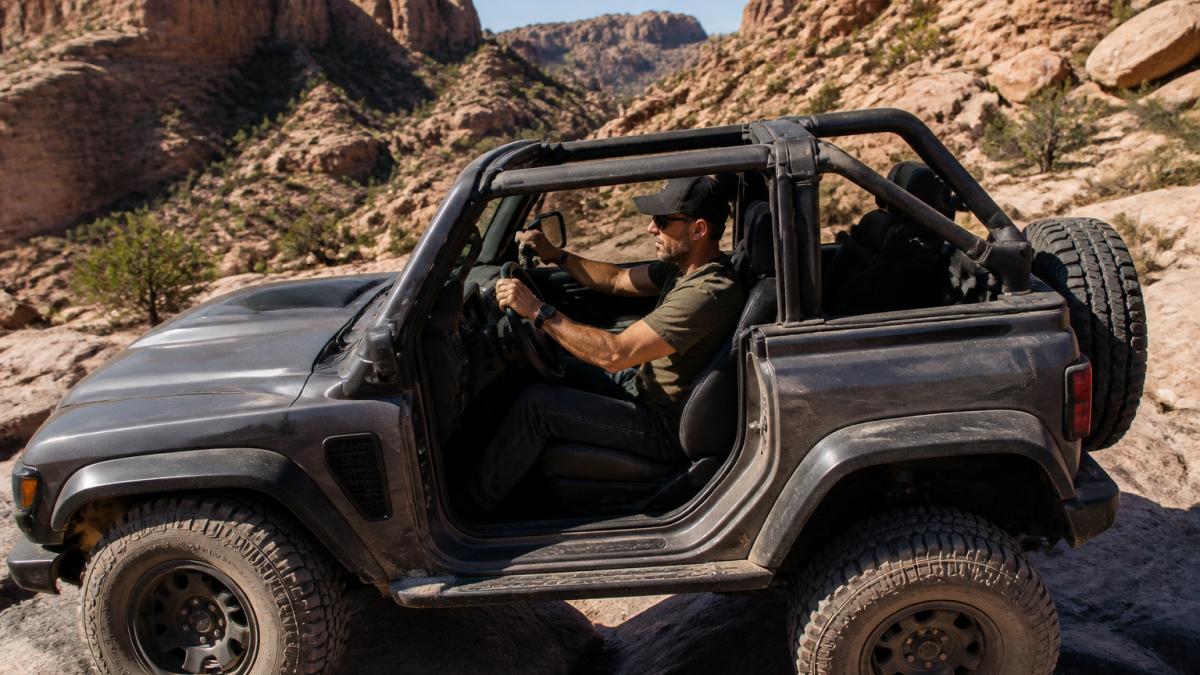
Jerky inputs, sudden steering, abrupt throttle, and hard braking destabilize your vehicle. Smooth, deliberate movements keep weight even and maintain traction.
For steep descents, shift into low gear before the drop and use engine braking.
Rock crawling demands finesse, not aggression. Learn the essential items and techniques for rock crawling beginners to master the skills and gear needed for this demanding terrain.
Off-Roading Safety Checklist Before You Hit the Trail
A pre-trip safety checklist prevents disasters. Before every trip, verify battery voltage, coolant, brake fluid, transmission fluid, differential fluid, and fuel. Check tire pressure and condition, test all lights, and confirm your spare is mounted and accessible.
| Item | Check | Status |
|---|---|---|
| Battery voltage | Test with multimeter | ✓ |
| Coolant level | Visual inspection | ✓ |
| Brake fluid | Check reservoir | ✓ |
| Tire pressure | Measure all four | ✓ |
| Tire condition | Inspect tread and sidewalls | ✓ |
| Spare tire | Verify mounting and condition | ✓ |
| Lights | Test all exterior lights | ✓ |
| Recovery gear | Winch, straps, shackles present | ✓ |
| Communication | Phone charged, two-way radio functional | ✓ |
| First aid kit | Stocked and accessible | ✓ |
Beyond the vehicle, prepare yourself. Bring at least one gallon of water per person, a first aid kit, a flashlight with extra batteries, and a multi-tool. You can learn the essential items required before heading out on trails to build a complete safety kit for your terrain.
Bring communication devices. Cell service is unreliable in remote areas, and a two-way radio or satellite communicator lets you call for help. Many off-roading mistakes become emergencies because drivers lacked basic safety gear and communication tools.
4H vs. 4L for Mud and Traction Control
The difference between 4H (high range) and 4L (low range) determines how much torque reaches your wheels and how slowly you can crawl. Getting this wrong is one of the most common off-roading mistakes, showing up as bogging down in 4H or over-revving in 4L.
What each range actually does
- 4H sends power to all four wheels through the transfer case in its high ratio, roughly 1:1. It is for moderate terrain, higher-speed dirt and gravel roads, light snow, and rutted roads where you need more traction than two-wheel drive but not maximum torque. Many vehicles are comfortable in 4H up to around 55 mph on loose surfaces, but check your owner's manual, because the limit varies by transfer case and tire size.
- 4L engages the transfer case's low ratio, commonly around 2.7:1 on many part-time 4x4 systems. That multiplies engine torque at the wheels and lets you crawl slowly with control. It is for deep mud, soft sand, steep climbs, rock crawling, and any situation where you need maximum traction at low speed.
When to shift and how
Shift into 4H before you need it, while moving slowly with the wheels straight. Many part-time systems allow shifting between 2H and 4H at low speed, but 4L usually requires stopping, shifting the transmission to neutral, and engaging low range. Check your manual for the exact procedure; some systems allow a rolling shift below a few mph.
The traction-control trade-off
Modern 4x4s use traction and stability control to prevent wheel spin by braking a spinning wheel and cutting throttle. That works on ice and light snow, but on rocks and deep mud it can work against you: controlled wheel slip is often what lets a tire climb a ledge or clean mud from the tread. Many vehicles have an off-road mode or button to reduce or disable traction control.
Unisex classic tee Moab's Okayest Spotter →
Matching range to terrain
- Deep mud: 4L, steady throttle, and momentum. Avoid spinning; spinning turns tires into paddles that dig.
- Soft sand: 4L or 4H depending on speed and flotation, with reduced tire pressure. Keep momentum and avoid abrupt throttle changes.
- Steep climbs: 4L for torque and control. Maintain steady momentum without wheel spin.
Common range mistakes
- Staying in 4H when the terrain calls for low range, then spinning tires and digging in.
- Using 4L on high-speed terrain, which over-revs the engine and heats the transfer case.
- Forgetting to return to 2H or 4H after a technical section, then driving fast in low range.
Knowing your vehicle's transfer-case ratios, speed limits for each range, and traction-control settings turns 4H and 4L from guesswork into a deliberate choice.
Off-Road Recovery Gear and When Not to Attempt Recovery
Recovery gear keeps you moving when you get stuck, but the gear is only half the equation. The other half is knowing what each piece is rated for, how to rig it correctly, and when to call for professional help. Most recovery injuries and vehicle damage trace back to three errors: the wrong strap, the wrong rigging point, or a pull from an unstable position.
Know what your gear is actually rated for
Recovery equipment is rated in working load limits, and mixing mismatched ratings is a common mistake. Practical benchmarks:
- Recovery straps vs. tow straps. A recovery strap stretches and stores energy, then releases it smoothly. A tow strap pulls a rolling vehicle and has little stretch. Using a tow strap as a recovery strap shock-loads attachment points and can break hardware. Look for a strap rated at roughly two to three times the weight of the stuck vehicle.
- Shackles and attachment points. Use rated screw-pin or bow shackles, not hardware-store clevis pins. A common pattern is to size shackles so the working load limit comfortably exceeds the strap's rating, so the strap is the fuse rather than the shackle.
- Winch sizing. A widely used rule of thumb is a winch rated at about 1.5 times the gross vehicle weight. A 5,000 lb vehicle points toward an 8,000 lb class winch; a loaded 6,000 lb rig points toward 9,000 lb or more. Undersized winches overheat.
Recovery gear safety and rigging guidance
Rigging rules that prevent the most common failures
- Never stand in line with a strap or winch line under tension. If a strap or line fails, it becomes a whip. Bystanders should stand outside the triangle formed by the anchor, the stuck vehicle, and the recovery vehicle, and well back from the line.
- Use dampers. Drape a heavy jacket, winch damper, or floor mat over a winch line or strap under load to absorb energy if it breaks.
- Rig to rated points only. Frame-mounted recovery points, rated bumpers, and factory tow hooks are designed for it. Axles, tie rods, and ball joints are not. A strap hooked to a tie rod can bend steering components and leave you stranded worse than before.
When not to attempt recovery
Recovery is the wrong call when:
- The vehicle is in or near moving water and the water is rising or the bank is undercut.
- The vehicle is on a slope steep enough that a pull could roll it, or the anchor is downhill of the stuck vehicle.
- The only anchor is a dead tree, a fence post, or a vehicle not rated for the pull.
In those cases, a professional recovery service is cheaper than a rolled vehicle or an injury. Many insurance policies and off-road club memberships include recovery coverage; check before you need it.
Build a recovery kit you can actually use
A practical kit: a recovery strap rated for the vehicle, two rated shackles, a tree saver, a snatch block, a winch (if set up for one), traction boards, a high-lift jack, gloves, and eye protection. Practice rigging in a safe, flat area before you need it, knowing each piece under low stress makes a real recovery calm instead of chaotic.
Off-Road Trail Etiquette and Environmental Responsibility
Trail etiquette isn't just courtesy, it preserves access to off-roading areas. Stay on marked trails.
Yield to uphill traffic when descending. Uphill drivers have the mechanical advantage and should keep momentum.
Pack out everything you pack in. Trash, fuel cans, and broken parts left on trails are eyesores and hazards.
Water crossings require care. Don't ford streams during high water, and avoid creating new crossings that damage banks.
Gear Up for Your Next Adventure
Understanding common mistakes when off-roading is the first step. Preparation, technique, and respect for terrain and community separate safe trips from dangerous ones.
The right gear makes a difference, too. The Unisex classic tee Moab's Okayest Spotter ($27.00) is built from 100% cotton with double seams at the sleeves and hem, the kind of durability you need on the trail. For a vintage look that holds up to real use, the Make Rock Crawling Great Again ($37.50) tee features 100% organic ring-spun cotton with a relaxed fit and garment-dyed finish.


Keep the sun off with one of our trail-inspired caps. The Garment washed baseball cap Make Rock Crawling Great Again ($25.00) brings that worn-in look from day one with 100% cotton construction and an adjustable strap. A Neck Gaiter ($25.00) protects your face from dust and sun, it's breathable, washable, and versatile enough to work as a headband, bandana, or wristband.

Before your next trail adventure, run through your pre-trip checklist, know your vehicle's limits, and practice smooth, controlled driving.
The difference between a rough day on the trail and a disaster often comes down to preparation and technique.
Frequently Asked Questions
What are the most common mistakes beginner off-roaders make?
Beginners often ignore vehicle limits, run tire pressure too high, spin tires when stuck, and drive too fast on unfamiliar terrain. Poor preparation, skipping pre-trip checks and not understanding ground clearance, causes most damage. Many also fail to recognize when recovery is unsafe or attempt it without proper off-road recovery gear. Start with a pre-trip inspection, reduce tire pressure for traction, practice speed control, and always know your vehicle's capabilities before tackling challenging trails.
What should you check before going off-road?
Create an off-roading safety checklist that includes tire condition and pressure, fluid levels (oil, coolant, brake), battery health, and undercarriage inspection for damage. Check that all lights work, your spare tire is inflated, and you have a jack rated for your vehicle. Verify your 4-wheel drive system engages smoothly and test your brakes on flat ground. Ensure your recovery gear is secure and you have a communication device. Review the trail difficulty against your vehicle's ground clearance and suspension capabilities.
Do you use 4H or 4L in mud?
Use 4L (low range) in mud to maximize traction and torque at lower speeds. 4L gives you better control and power through deep mud without wheel spin. Use 4H (high range) only on hard-packed terrain at higher speeds. In mud, 4L prevents the transmission from working too hard and reduces the risk of overheating. Pair 4L with reduced tire pressure for flotation and maintain steady momentum without spinning tires, which digs you deeper into mud.
Why should you avoid spinning your tires when stuck?
Spinning tires when stuck digs your vehicle deeper into mud, sand, or soft terrain. The friction generates heat that can damage tires and rims, and the digging action creates a deeper rut that's harder to escape. Tire spin also wastes fuel and can damage your transmission or differential. Instead, stop, assess your situation, reduce tire pressure slightly for better flotation, and use steady throttle control or off-road recovery gear to extract yourself safely.
