

Table of Contents
- The 5 Essential Items for Off-Roading in Moab
- 1. Recovery Gear: Your Moab Off-Road Recovery Equipment
- 4. Navigation and Communication: What to Pack for Off-Roading in Moab
- 5. First Aid and Emergency Kit: Your Moab Off-Road Emergency Kit
- Pre-Trip Vehicle Preparation Checklist
- Essential Items Packing Summary
- Frequently Asked Questions
Last Updated: October 10, 2026
The 5 Essential Items for Off-Roading in Moab
Moab's backcountry trails demand respect and preparation. The terrain is unforgiving, rocky, remote, and far from cell service. Without the right gear, a mechanical failure or unexpected weather shift can turn an adventure into a survival situation fast.
This guide breaks down the essential items off-roading Moab demands, the five things that separate prepared off-roaders from stranded ones and make the difference between a successful day and a costly rescue.
1. Recovery Gear: Your Moab Off-Road Recovery Equipment
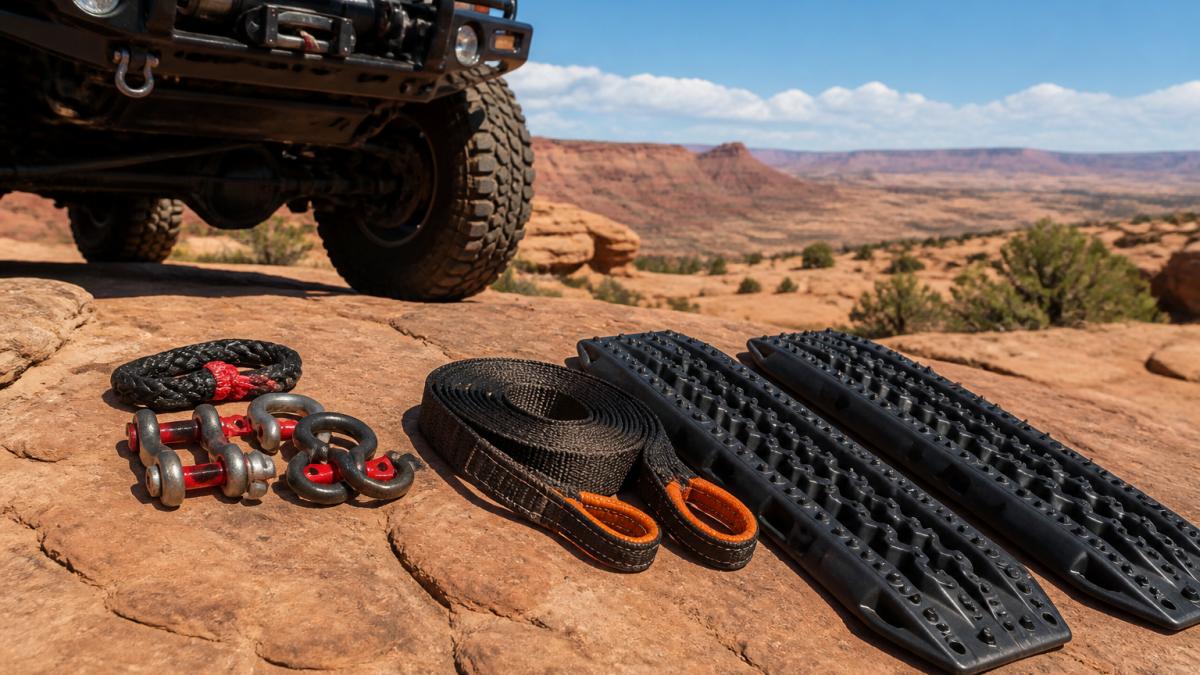
Recovery gear is non-negotiable on Moab's technical trails. Self-recovery saves thousands in towing fees and keeps your adventure moving.
- Lightweight pants (not shorts): Protects legs from sun, brush, and sharp rocks. Avoid heavy denim, it traps heat. Look for quick-dry synthetics or lightweight canvas.
Apply SPF 30+ sunscreen before you leave and reapply every 2 hours. Sunburn impairs judgment and drains energy, it's a safety issue.
4. Navigation and Communication: What to Pack for Off-Roading in Moab
Cell service in Moab backcountry is spotty. GPS and offline maps are your lifeline. Getting lost burns fuel, increases risk, and can trigger rescues.
Navigation essentials:
- Offline maps (printed or digital): Download topographic maps of your route using apps like AllTrails, Gaia GPS, or OnX Maps before you head out. Print a paper map as backup, batteries die, screens crack, and digital devices fail.
- GPS device or smartphone with offline capability: A dedicated GPS unit (Garmin, for example) is more reliable than a smartphone in remote areas. If using a phone, download offline maps and enable airplane mode to preserve battery.
- Compass: A basic orienteering compass is lightweight insurance. If your GPS fails, a compass and map keep you on course.
Communication backup:
- Satellite communicator or personal locator beacon (PLB): Devices like Garmin InReach or SPOT allow you to send SOS signals and check-in messages when cellular is unavailable. Not required for day trips, but invaluable for remote expeditions.
- Fully charged power bank: Keeps your phone alive long enough to call for help if service returns.
Moab's terrain changes fast. Stop at visitor centers, check current trail conditions online, and talk to other riders before you go.
5. First Aid and Emergency Kit: Your Moab Off-Road Emergency Kit
Minor injuries happen on the trail. A well-stocked first aid kit and emergency supplies prevent small problems from becoming major ones.
First aid essentials for Moab:
- Blister treatment: Moleskin, blister pads, and athletic tape. Blisters from hiking to a trailhead can sideline your whole day.
- Wound care: Antibiotic ointment, sterile gauze, adhesive bandages, and tweezers for cactus spines. Moab's plants are sharp.
- Pain relief: Ibuprofen and acetaminophen for headaches and minor injuries.
Emergency supplies:
- Multi-tool or knife: For repairs, first aid, and camp tasks.
- Fire starter (waterproof matches, lighter, fire starter): For warmth if you're stranded overnight.
- Emergency blanket or bivy sack: Lightweight and compact. Hypothermia is a risk even in mild weather if you're wet and stranded.
Dehydration happens before you feel thirsty in Moab's intense sun and dry air. Drink water on a schedule, not on demand. Cactus spines are everywhere, wear long sleeves and sturdy boots.
Pre-Trip Vehicle Preparation Checklist
Inspect your vehicle before every trip.
Critical inspections for Moab terrain:
| System | Check | Why It Matters on Moab Terrain | Frequency |
|---|---|---|---|
| Tires | Pressure (check cold), tread depth (minimum 4/32"), sidewall cracks, punctures | Slickrock and sharp rocks puncture tires constantly. Low pressure causes sidewall damage on rocky terrain. Bald tires lose traction on slickrock and sand. | Every trip |
| Undercarriage & Skid Plates | Skid plates secure, no hanging components, cracks in plates, damage to frame | Slickrock scrapes undercarriages aggressively. Loose skid plates rattle and can detach. Cracked plates expose fuel tanks and transmission to rocks. | Every trip |
| Suspension | No clunking, bushings intact, shocks working, no leaks from struts | Sand and rocks wear suspension components faster than road driving. Worn bushings cause poor handling on technical terrain and increase rollover risk. | Every trip |
| Engine | Oil level, coolant level, fluid leaks, air filter condition | Sand ingestion clogs air filters quickly in Moab. Low oil causes overheating on long climbs. Coolant leaks are critical in heat. | Every trip |
| Brakes | Fluid level, pad thickness (minimum 3/32"), responsiveness, no sponginess | Technical descents demand reliable brakes. Brake fade on long downhills can cause loss of control. Low fluid or worn pads are dangerous. | Every trip |
| Battery | Terminals clean, charge level, corrosion, secure mounting | Desert heat drains batteries faster. Corroded terminals prevent starting. A dead battery miles from help is a rescue call. | Every trip |
| Lights | Headlights, taillights, brake lights, high beams functional | If you're out past sunset, headlights are essential. Brake lights alert other riders behind you. | Every trip |
| Fluids | Top off oil, coolant, brake fluid, transmission fluid, power steering fluid | Moab's heat and elevation increase fluid consumption. Low levels cause overheating and loss of power steering. | Every trip |
| Hoses & Belts | Cracks, leaks, fraying, secure clamps | A radiator hose failure in Moab backcountry means overheating and engine damage. Serpentine belt failure leaves you stranded. | Monthly or before long trips |
| Fuel System | Tank secure, no leaks, fuel cap tight, fuel filter clean | Sand can clog fuel filters. A leaking fuel tank is a fire hazard and wastes fuel. | Every trip |
| Exhaust System | No loose hangers, no dragging components, no leaks | Rocks can damage mufflers and catalytic converters. Dragging exhaust creates sparks and fire risk in dry brush. | Every trip |
| Electrical Connections | Battery terminals, alternator output, starter function | Vibration on rough terrain loosens electrical connections. A failing alternator leaves you with a dead battery far from help. | Monthly |
Vehicle-specific preparation:
Garment washed baseball cap Hells Revenge, Moab Utah →
Stock or lightly modified SUVs: Reduce tire pressure to 18-22 psi for sand and slickrock; increase before paved roads.
Modified 4x4s: Check differential and transfer case fluid. Verify locking differentials engage smoothly. Inspect upgraded suspension for leaks and worn bushings.
Multi-day or remote expeditions: Perform a full inspection 48 hours before departure. Carry spare belts, hoses, radiator clamps, and a basic tool kit.
What to carry for roadside repairs:
- Spare serpentine belt (know your vehicle's size)
- Radiator hose clamps and spare hose sections
- Spare radiator cap
Essential Items Packing Summary
The essential items off-roading Moab requires are recovery gear, extra fuel and water, appropriate clothing, navigation tools, and a comprehensive emergency kit.
The Trail Explorer's garment-washed baseball caps are made with 100% cotton and feature an adjustable strap. Pick one named after your favorite Moab trail: Hells Revenge, Pritchett Canyon, or Kane Creek.


Get prepared, stay safe, and own your adventure.
According to the Leave No Trace Center for Outdoor Ethics, responsible backcountry travel means planning routes, staying on established trails, and respecting wildlife habitats.
For vehicle recovery techniques and off-road safety, the American Hiking Society's trail safety guidelines emphasize communication, navigation, and emergency preparedness as the foundation of safe outdoor travel.
The National Park Service's guide to desert hiking and off-road safety recommends carrying water, sun protection, and navigation tools as baseline requirements for any backcountry expedition in arid environments like Moab.
Frequently Asked Questions
What should I bring for off-roading in Moab?
The five essential items for off-roading in Moab are recovery gear (tow straps, D-rings, soft shackles), extra fuel in jerry cans, water and food for hydration, appropriate layered clothing with sun protection, and navigation tools plus a first aid kit. Each addresses specific hazards of backcountry trails: mechanical recovery, fuel range on remote routes, heat exposure in desert conditions, and emergency response capability.
What recovery gear do I need for a Moab off-road trip?
Essential recovery gear includes a tow strap rated for your vehicle's weight, at least two D-rings or recovery points, soft shackles to prevent whipping, and recovery boards for traction on sand or slick rock. This equipment lets you self-recover from high-centering or soft ground situations common on challenging trails. Carry gloves to protect your hands during recovery operations, and consider a winch if tackling difficult terrain regularly.
What should I wear for off-roading in Moab?
Wear moisture-wicking base layers, lightweight long sleeves to block sun and abrasion, and durable pants. Layer a breathable jacket for temperature swings. Apply sunscreen with at least SPF 30 and lip balm with SPF before heading out. Closed-toe boots with ankle support handle rocky terrain better than sneakers. Desert sun is intense at elevation, and temperature can drop 20-30°F from midday to evening, so layering is critical for safety and comfort.
How much water should I carry for off-roading in Moab?
Carry at least one gallon of drinking water per person for a half-day trip, and two gallons per person for a full day. Moab's dry desert climate accelerates dehydration, especially at higher elevations where trails often sit above 4,000 feet. Bring an extra gallon for vehicle cooling in case of overheating. Store water in insulated containers to keep it cool, and drink regularly even if you don't feel thirsty.
What tools and supplies should I keep in my off-road vehicle?
Keep a basic tool kit with adjustable wrenches, pliers, screwdrivers, and a multi-tool. Include spare belts, hoses, extra coolant, engine oil, and brake fluid. Pack a tire repair kit, spare tire, and a compressor or hand pump. Bring jumper cables, a flashlight with spare batteries, and a fire extinguisher. Store these items in a secure container to prevent shifting during rough terrain.