

Table of Contents
- Start With Your Ride: Matching Apparel to the Trail
- Trail Riding Apparel Fabrics: Breathable vs. Heavy-Duty
- The Best Shirts for Outdoor Adventure: What to Look For
- Building Durable Off-Road Riding Gear, Layer by Layer
- Safety Gear for Side-by-Side Riding: Helmets, Goggles, and More
- Fit, Sizing, and Gender-Specific Nuances
- Caring for Your Gear: Maintenance and Packing Tips
- Conclusion
- Frequently Asked Questions
Last Updated: September 14, 2026
Start With Your Ride: Matching Apparel to the Trail
The right trail riding apparel depends on what you're riding. A side-by-side UTV driver faces dust, wind, and engine heat; a dirt bike rider needs maximum impact protection; an equestrian needs flexibility and grip. Getting this match wrong is a common mistake, leading to gear that restricts movement or leaves you exposed.
Trail riding apparel is specialized clothing and protective equipment designed to keep riders safe, comfortable, and visible off-road. It handles dust, debris, engine heat, and sudden weather shifts while providing impact protection where it matters.
Before you buy, answer three questions: What are you riding? What terrain will you cover (rock, mud, sand, forest)? How long are your typical rides? Your answers determine everything from fabric weight to armor placement.
Trail Riding Apparel Fabrics: Breathable vs. Heavy-Duty
Fabric choice comes down to one trade-off: breathability versus abrasion resistance. Most riders need both in different zones, so don't buy one fabric type for the entire outfit.
When Moisture-Wicking Matters Most
Moisture-wicking fabrics pull sweat to the surface where it evaporates, critical in summer heat and on multi-hour sessions working the wheel or handlebars. Polyester and nylon blends outperform cotton, which holds moisture and stays heavy when wet.
Abrasion-Resistant Materials for Rock and Brush
Rock crawling and tight forest trails punish your gear. Abrasion-resistant materials like reinforced nylon, polyester blends, and synthetic leather panels protect against scrapes, branch strikes, and rock contact. Prioritize them in high-contact zones: shoulders, forearms, and knees.
| Fabric Type | Best For | Trade-Off |
|---|---|---|
| Polyester mesh | Hot weather, high exertion | Less abrasion resistance |
| Nylon blend | Mixed terrain, durability | Heavier, less breathable |
| Fleece (polyester) | Cold rides, layering | Not for hot conditions |
| Cotton-poly blend | Casual trail days | Retains moisture |
The Best Shirts for Outdoor Adventure: What to Look For
The best shirts for outdoor adventure balance ventilation, durability, and fit: breathable polyester mesh in summer, heavier blends for shoulder seasons, and relaxed cuts that allow full arm movement without excess fabric that snags.

Key features to check:
- Ventilation zones under the arms and across the back
- Flatlock seams to prevent chafing under a harness or backpack
- Extended length so the shirt stays tucked when you're seated and reaching
- Relaxed fit that layers over a base layer without bunching
REI's guide to layering for outdoor activities explains how fabric weight affects thermal regulation across activity levels, which applies directly to trail riding where your exertion fluctuates between slow technical sections and faster open stretches.
For warmer rides, a breathable mesh jersey keeps air moving; for cooler mornings, a heavyweight tee with a fleece layer handles temperature swings without a full wardrobe change.
Building Durable Off-Road Riding Gear, Layer by Layer
Durable off-road riding gear works as a system, not a single piece. The three-layer approach, base layer, mid-layer, and outer shell, lets you adapt to changing conditions without carrying multiple outfits.
Base Layer, Mid-Layer, and Outer Shell
Base layer: Sits against your skin for moisture management. Choose moisture-wicking synthetic fabric, never cotton, a lightweight mesh jersey in summer, a fitted synthetic tee in winter.
Mid-layer: Traps warmth. A fleece jacket is the standard choice here. The Columbia fleece jacket from The Trail Explorer uses 100% polyester MTR filament fleece at 7.4 oz./yd², which provides thermal retention without bulk under an outer shell.

Outer shell: Blocks wind, water, and debris. Look for a waterproof membrane and sealed seams. This layer takes the abuse from branches, dust, and rain.
Safety Gear for Side-by-Side Riding: Helmets, Goggles, and More
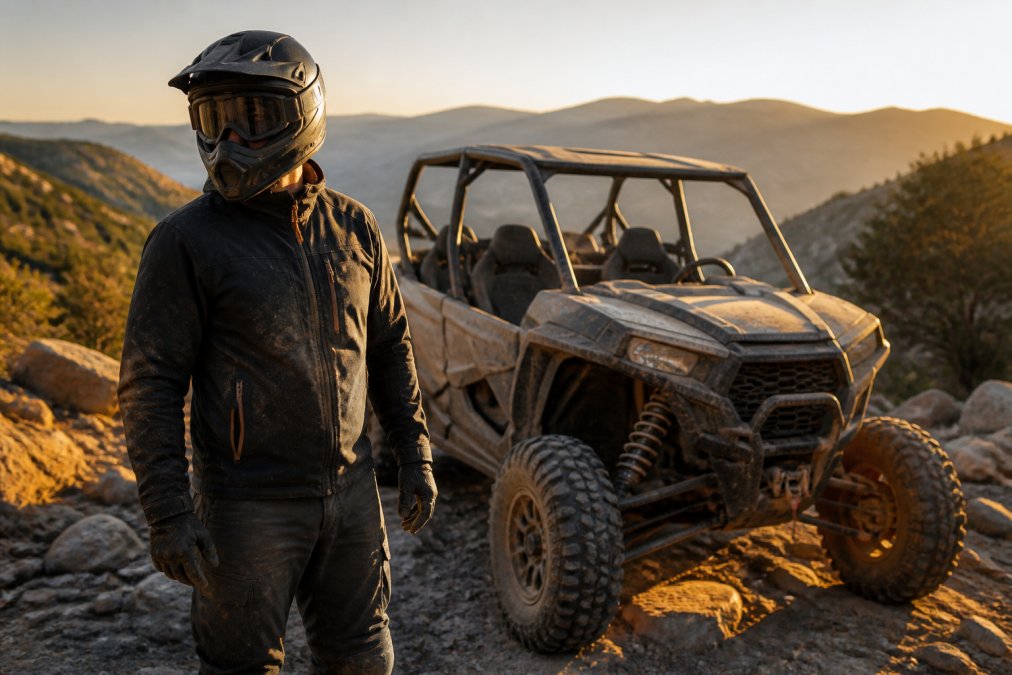
Safety gear for side-by-side riding starts with a helmet, but it doesn't end there. In a side-by-side you're strapped in, so the threats are rollover impact, debris intrusion through an open cab, and dust. On a dirt bike you separate from the machine, so abrasion and joint impact dominate. Match the gear to the failure mode.
Helmet: Certification and Fitment
For side-by-side and dirt bike riding, look for a full-face helmet with current certification. In the U.S., the two you'll see most often are DOT (Federal Motor Vehicle Safety Standard 218) and Snell (Snell Memorial Foundation M2020D or M2020R for motorcycle helmets) (nhtsa.gov). DOT is the legal minimum for on-road use; Snell and ECE 22.06 are stricter voluntary standards. For pure off-road use, many riders choose a longer chin bar and visor peak, and some sanctioning bodies require specific certification for competition, check your event rules before you buy.
Fitment matters more than the sticker. A helmet should press evenly against your forehead and cheeks with no pressure points, and forehead skin should move when you rotate it side to side. More than a finger between brow pad and forehead means too loose; cheeks pushed into your teeth means too tight. A heavier shell fatigues your neck, but the lightest isn't always safest, shell material and liner density matter more than grams.
Goggles and Eye Protection
Dust and debris are constant on trails, and in an open-cab side-by-side you're eating roost from the machine ahead. Goggles with tear-offs or roll-offs let you clear your vision without stopping; look for an anti-fog coating and a strap wide enough to sit over the helmet shell. Fit the goggle to the helmet, one that doesn't seal against the eye port leaks dust at speed. For equestrian trail riding, a helmet with a fixed visor plus sunglasses or clear safety glasses is the norm, since goggles over a riding helmet can interfere with the brim.
Gloves: Grip, Dexterity, and the Discipline Split
Grip and dexterity matter more than padding for most trail riders. Ergonomic gloves with reinforced palms protect against blisters and branch strikes while letting you work controls precisely.
- Side-by-side and dirt bike: Look for a reinforced palm and knuckle guard. Dirt bike gloves often add a hard knuckle shell; UTV drivers can get away with a lighter glove because the steering wheel doesn't transmit the same vibration.
- Equestrian: Look for a leather or synthetic-leather palm with rein grip and no bulk between your fingers. A padded palm can reduce rein feel, a safety issue on a spooky horse.
Protective Footwear
Ankle support and a stiff sole are non-negotiable, uneven ground means a rolled ankle ends your day fast. For motorized riding, a purpose-built motocross or ATV boot with a hinged ankle and steel or composite shank is standard. For equestrian riding, a boot with a distinct heel (to prevent your foot sliding through the stirrup) and a smooth sole that releases from the stirrup is the safety requirement; a deep-lug hiking sole can trap your foot. Don't substitute work boots, the sole and ankle geometry are wrong for the job.
The Rest of the Kit
Beyond the four core pieces, the gear that separates a comfortable day from a miserable one:
- Chest and back protection: A roost deflector or pressure suit for dirt bike and aggressive UTV riding. Equestrian riders typically use a body protector rated to a recognized standard.
- Neck brace: Common in motocross to limit hyperextension; worth considering for technical terrain at speed.
- Kidney belt: Supports your lower back on long, rough rides and protects the kidneys from impact.
- Visibility: A high-visibility vest or bright helmet color matters on shared-use trails with horses, hikers, or oncoming traffic.
Fit, Sizing, and Gender-Specific Nuances
Fit is where most gear guides fall short, and it's the biggest reason riders end up with gear that rides up, binds at the shoulders, or leaves gaps at the wrists. A jacket that fits a 5'10" rider with a 32" inseam won't fit a 6'2" rider with a longer torso, even at the same labeled size.
Measure These Five Numbers Before You Buy
Ignore the size letter until you've measured. Use a soft tape measure over a thin base layer and write these down:
- Chest, around the fullest part, tape level under the arms.
- Waist, at your natural waist, not where your pants sit.
- Hip, around the fullest part of your seat.
- Torso length, from the base of your neck to your natural waist.
- Inseam, from your crotch to the floor in bare feet.
Compare those numbers to the specific brand's size chart, not a generic one, riding apparel brands cut differently, and a medium in one line can fit like a small in another. Between sizes, size up for outer shells and down for base layers.
Why Gender-Specific Fit Isn't Just Marketing
Women's trail riding apparel typically adjusts for shoulder width, torso length, and hip-to-waist ratio; men's gear runs longer in the torso and wider in the shoulders. Unisex rarely fits either group perfectly. The practical differences:
- Shoulder-to-hip ratio: Women's gear narrows at the shoulder and flares at the hip; men's does the opposite. A unisex jacket on a rider with a pronounced hip-to-shoulder difference will bind at the hip or gap at the shoulder.
- Torso length: Women's torsos are, on average, shorter relative to height. A men's jacket on a woman often bunches at the waist and pushes the armor pockets out of position.
- Arm length and sleeve taper: Women's sleeves are typically shorter and taper more at the forearm. A men's sleeve can swallow the hand or leave the cuff loose enough to snag.
- Chest and bust shaping: Women's protective gear often includes a shaped chest panel or removable liner to accommodate a chest protector without crushing. Men's gear assumes a flat chest.
If you're a woman shopping a men's line because the women's line doesn't carry your size, plan to have the waist taken in and sleeves shortened. If you're a man shopping a women's line for a narrower fit, check shoulder width first, that seam can't be easily altered.
Body-Type Adjustments That Actually Work
- Long torso: Look for extended-length cuts, or size up and have the waist adjusted. A jacket that rides up exposes your lower back to branches and cold air.
- Broad shoulders: Prioritize relaxed fits with gusseted underarms, so you can reach the bars or reins without the jacket pulling across your back.
- Short inseam: Riding pants with a shorter inseam option, or have a tailor hem them. A pant that pools over your boot catches on pegs and stirrups.
- Long arms: Look for articulated sleeves or tall sizing. A sleeve that ends above the wrist leaves a gap between glove and jacket, a common entry point for cold air and debris.
- Petite frame: Women's petite or youth sizing in some brands beats an adult XS, which is often cut for a taller frame.
Discipline-Specific Fit Trade-Offs
Fit priorities shift by discipline:
- Side-by-side: You're seated and strapped in, so torso length and shoulder mobility matter most. A jacket that binds when you reach for the wheel will fatigue you.
- Dirt bike: You're standing and moving on the pegs, so sleeve and pant articulation matter more than torso length. Look for pre-curved sleeves and knees.
- Equestrian: You're sitting deep with a long leg, so seat and knee fit dominate. A pant too tight at the knee restricts your leg aid; too loose and it bunches under your calf.
Caring for Your Gear: Maintenance and Packing Tips
Technical apparel loses performance when it's dirty or stored wrong. Dust clogs breathable membranes. Sweat and body oils break down water-repellent coatings. Mud left on abrasion-resistant panels hides damage until it becomes a tear.
A simple maintenance routine:
- Rinse mud and dust off after every ride
- Wash technical fabrics in cold water with mild detergent (no fabric softener)
- Hang dry, never machine dry, to protect membranes and coatings
- Reapply water-repellent treatment when water stops beading
- Inspect seams, zippers, and armor pockets before each season
For multi-day trips, pack layers by function, not outfit. Roll base layers tightly, keep your outer shell at the top of your bag, and bring one extra base layer per day plus one mid-layer for every two days.
Leave No Trace guidelines for outdoor recreation recommends packing out everything you bring in, which applies to gear wrappers, torn tear-offs, and worn-out items.
Conclusion
Building the right trail riding apparel system takes more thought than grabbing a random jacket. Riders who stay comfortable, protected, and visible matched their gear to their terrain, layered properly, and maintained what they bought.
The Trail Explorer builds apparel for exactly this kind of rider. Our heavyweight tees and headwear are designed for off-road enthusiasts who want gear that holds up to rock crawling and trail exploration. The Under Armour athletic t-shirt offers a quick-drying cotton-poly blend for warm-weather rides, while our neck gaiter doubles as a face covering, headband, or neck warmer depending on conditions.

Subscribe to our emails for new gear drops, trail tips, and early access to limited designs built for the off-road community.
Frequently Asked Questions
What clothes are best for trail riding?
The best trail riding apparel depends on your machine and weather, but the core setup is similar: a moisture-wicking base layer, an insulating mid-layer like a fleece, and a weatherproof outer shell. Add abrasion-resistant pants, gloves for grip, and a full-face helmet for side-by-side riding. Look for breathable polyester and nylon blends that manage sweat while standing up to brush and rock contact.
Why is moisture-wicking fabric important for outdoor adventure gear?
Moisture-wicking fabric pulls sweat away from your skin so it evaporates instead of soaking your layers. On a long trail day, wet cotton stays damp, chills you when temperatures drop, and rubs against your skin. Polyester and nylon blends dry faster and keep you comfortable whether you are working hard in the saddle or stopped for a break. It is one of the highest-value upgrades you can make to your trail riding apparel.
How do I choose between heavyweight and lightweight fabrics for off-road riding?
Pick based on your machine and trail conditions. Side-by-side and rock crawling riders usually want heavier fabrics for abrasion resistance and wind blocking. Dirt bike and ATV riders who generate more body heat often prefer lighter, breathable materials with ventilation. Many riders split the difference with a lightweight base layer under a heavier outer shell, so they can adjust as the day warms up or cools down.
Is it necessary to wear specialized gear for UTV and side-by-side trail riding?
Yes, specialized gear makes a real difference. Side-by-side riding exposes you to dust, debris, sun, and weather with less protection than a closed vehicle. A full-face helmet with goggles, gloves, a neck gaiter, and abrasion-resistant layers protect you from trail hazards. CE-rated padding and articulated joints add impact protection without restricting movement, which matters on technical terrain.