

Table of Contents
- Why Fit Is the First Problem Tall Off-Roaders Face
- Headroom, Legroom, and Cabin Volume: What the Numbers Mean
- Tall Driver Seat Adjustments for Off-Roading
- Ergonomic Off-Road Vehicle Modifications for Tall Drivers
- Vehicle Class Comparison: SUVs vs. Trucks vs. UTVs for Tall Off-Roaders
- The Ergonomic Test-Drive Checklist for Tall Drivers
- Heavyweight Apparel for Tall Outdoor Enthusiasts
- Frequently Asked Questions
Last Updated: September 1, 2026
Why Fit Is the First Problem Tall Off-Roaders Face
Most vehicles are engineered for drivers between 5'8" and 5'11". If you're 6'2" or taller, you're an afterthought in cockpit design. Off-road driving compounds every ergonomic problem that tall drivers tolerate on the highway. On a trail, you're making constant micro-corrections, bracing against lateral body roll, and craning your neck to spot line choices. A seat that's "close enough" for a commute becomes a liability when picking a line through a boulder field.
Fit is a solvable problem. According to ergonomic guidelines published by the Human Factors and Ergonomics Society, driver seating position directly affects reaction time, fatigue onset, and injury risk, all amplified in off-road environments where terrain is unpredictable.
Headroom, Legroom, and Cabin Volume: What the Numbers Mean
Interior dimensions are the starting point for any serious vehicle fit assessment. Headroom is measured from the seat cushion to the headliner at the tallest point above the seating position. A figure above 40 inches is generally workable for drivers up to 6'4". Below 38 inches, drivers over 6'0" will find their head contacting the headliner on moderate trail articulation.
Legroom is measured from the back of the seat to the firewall at full seat travel. Most full-size trucks and body-on-frame SUVs offer 43-45 inches of front legroom, but seat travel is the limiting factor. Many seats run out of track before a 6'4" driver reaches a comfortable knee angle.
| Measurement | Minimum for 6'2" Drivers | Comfortable for 6'4"+ |
|---|---|---|
| Front headroom | 39.5 inches | 41+ inches |
| Front legroom | 43 inches | 45+ inches |
| Seat travel (rearward) | 8 inches | 10+ inches |
| Hip point height | 9 inches from floor | 11+ inches |
| Steering column reach | 3-inch telescoping range | 4+ inches |
Long Torso vs. Long Legs: Two Different Fit Problems
A 6'3" driver with a long torso and average-length legs has entirely different ergonomic needs than a 6'3" driver with a long inseam.
Long-torso drivers hit the headliner first. Their hip point is often fine, but their shoulder height and head position conflict with the roofline and A-pillars. They also sit with their arms at an awkward angle to the steering wheel because the wheel is too low relative to their shoulder height.
Long-leg drivers run out of seat travel. Their primary complaint is a compressed knee angle, which creates both discomfort on long runs and a safety concern if the airbag deploys. Adjustable pedals can shift the footwell forward by 2-3 inches, making a meaningful difference.
The fix isn't the same for both. Long-torso drivers need headroom solutions and steering column rake adjustment. Long-leg drivers need seat rail extensions and pedal box modifications.
Sunroof Trade-Offs and Helmet Clearance for Off-Road Use
Sunroofs reduce headroom. A factory panoramic sunroof typically costs 1.5 to 2.5 inches of vertical clearance. For a 6'4" driver already operating near the headroom limit, that's a deal-breaker.
The helmet clearance issue is critical for drivers who run sanctioned off-road events or technical trail rides where helmets are required. A full-face helmet adds roughly 3-4 inches to your effective head height. If you're buying a vehicle for serious off-road use and you wear a helmet, subtract 4 inches from the published headroom figure. Any figure below 38 inches after that calculation means you need a vehicle in a different class or a significant seat modification.
Tall Driver Seat Adjustments for Off-Roading
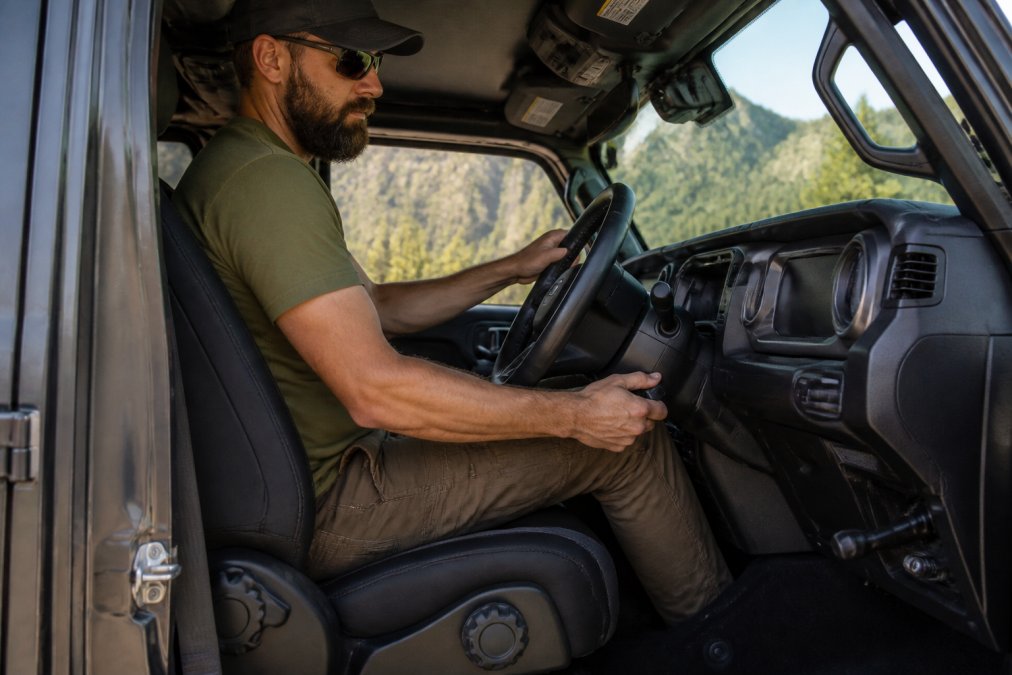
The seating position you use on the highway is almost certainly wrong for the trail. The ideal off-road seating position for a tall driver places the hips slightly above the knees, the back supported fully by the lumbar region of the seat, and the arms with a slight bend at the elbow when hands are at the 9-and-3 position on the wheel. This slightly more upright position improves your sightlines over the hood and keeps your weight better centered when the vehicle is articulating aggressively.

Steering Column Rake, Telescoping Reach, and Pedal Box Position
Steering column rake refers to the up-down tilt adjustment. Most modern trucks and SUVs offer rake adjustment, but the range varies. A tall driver typically needs maximum rake to clear the thighs and allow a natural arm position.
Telescoping reach moves the wheel toward or away from you. Extending the column forward by 2-3 inches allows a tall driver to sit further back while maintaining a bent-elbow position. According to automotive ergonomics research from the Society of Automotive Engineers, telescoping steering columns reduce upper-body fatigue by allowing drivers to maintain a neutral shoulder position over extended drives.
Pedal box position is the least adjustable element in most stock vehicles. Adjustable pedals, offered on some trucks as an option, shift the accelerator and brake forward by 2-3 inches. For long-leg drivers, this is one of the most impactful changes available without modifying the vehicle structure.
Sightlines, Visibility, and Entry/Exit Ease on the Trail
Tall drivers sitting high in the seat can find the A-pillar obstructs their forward-diagonal view. On a trail where you're reading terrain at low speed, adjusting your seating position slightly lower if headroom allows can help. Entry and exit ease on the trail is underrated as a fit criterion. Lifted vehicles with rock sliders require a step-up that works differently for tall drivers. Running boards set at the right height make a significant difference.
Ergonomic Off-Road Vehicle Modifications for Tall Drivers
The stock configuration of most off-road vehicles is a starting point, not a final answer. The most common mistake is jumping to expensive modifications before exhausting the adjustability already in the vehicle.
Aftermarket Seat Rail Extensions and Low-Profile Seat Bases
Aftermarket seat rail extensions are the single most impactful modification for tall drivers who've run out of seat travel. Standard seat rails in most trucks and SUVs offer 6-8 inches of fore-aft travel. Extended rails push that to 10-12 inches, often solving a legroom problem completely. Installation typically takes 2-3 hours with basic hand tools and is reversible.
Low-profile seat bases address the headroom problem from the other direction. Replacing a factory seat with an aftermarket racing-style seat mounted on a low-profile base can recover 1-2 inches of headroom. The trade-off is that many aftermarket seats offer less lateral bolstering and lumbar support than factory units.
| Modification | Headroom Gain | Legroom Gain | Difficulty | Reversible |
|---|---|---|---|---|
| Seat rail extension | None | 2-4 inches | Moderate | Yes |
| Low-profile seat base | 1-2 inches | None | Moderate | Yes |
| Aftermarket slim seat | 1-3 inches | None | Moderate | Yes |
| Adjustable pedals (factory) | None | 2-3 inches | N/A (factory option) | N/A |
| Steering column spacer | None | None | Easy | Yes |
Roll Cage Clearance and Cockpit Layout Adjustments
For drivers running UTVs or purpose-built off-road vehicles with roll cages, helmet clearance is a structural constraint. Roll cage geometry determines the maximum head height inside the cockpit, and for tall drivers, the factory cage on many UTVs creates genuine clearance problems when wearing a helmet.
The practical options are limited: lower-profile helmet designs, seat-lowering modifications, or custom cage fabrication. For trail riders, a seat-lowering bracket combined with a low-profile helmet is usually sufficient.
Vehicle Class Comparison: SUVs vs. Trucks vs. UTVs for Tall Off-Roaders
The best fit guide for tall off-roaders has to address vehicle class, because the ergonomic profile of an SUV, a full-size truck, and a UTV are fundamentally different.
Full-size body-on-frame SUVs generally offer the best combination of headroom and legroom for tall drivers. Their taller rooflines and higher hip points create more vertical clearance, and the longer wheelbases support more seat travel.
Full-size pickup trucks are a close second. Extended and crew cab configurations give tall drivers enough rear cabin depth to push the front seat back without losing usable interior space. The seating position in most modern trucks is also high, which benefits sightlines.
UTVs are the most challenging class for tall off-roaders. Most production UTVs are designed around a 5'8"-6'0" driver envelope. Tall drivers frequently contact the roll cage and struggle with harness fit. That said, UTVs offer the most scope for custom modification because the cockpit is more accessible.
| Vehicle Class | Headroom | Legroom | Modification Scope | Trail Maneuverability |
|---|---|---|---|---|
| Full-size SUV | Best | Good | Moderate | Moderate |
| Full-size Truck | Good | Best | Moderate | Good |
| Mid-size SUV | Moderate | Moderate | Limited | Best |
| UTV | Limited | Limited | High | Best |
| Mid-size Truck | Moderate | Good | Moderate | Good |
The Ergonomic Test-Drive Checklist for Tall Drivers
Most people test-drive a vehicle for 15 minutes on a flat road. That tells you almost nothing about how it fits on the trail.

Before you start the engine:
- Set the seat to maximum rearward travel. Can you reach the pedals comfortably with a slight knee bend?
- Set the seat height to maximum. Does your head clear the headliner by at least 2 inches?
- Extend the steering column to maximum reach. Are your elbows still bent at roughly 120 degrees?
- Adjust the steering column to maximum rake. Does the wheel clear your thighs through a full lock-to-lock turn?
- Sit upright with full lumbar contact. Can you see the hood line and the ground 10 feet in front of the vehicle?
With your helmet on (if applicable):
- Does your helmet contact the headliner at any point?
- Can you turn your head fully left and right without the helmet touching the A-pillar or B-pillar?
- Does the sun visor create a vision obstruction at your eye height?
On the move:
- After 20 minutes of driving, is there any numbness in your thighs?
- Can you comfortably look left and right at intersections without the A-pillar blocking your view?
- Does the thigh support extend far enough to support the full length of your femur?
Entry and exit:
- Can you step in and out without an awkward hip flexion angle?
- If the vehicle is lifted, does the step height work for your leg length?
Heavyweight Apparel for Tall Outdoor Enthusiasts
Fit problems don't stop at the vehicle door. Standard-sized tees ride up, sleeves end at the forearm, and torso lengths leave a gap above your waistband when you're reaching across a cab or crouching to check a tire.
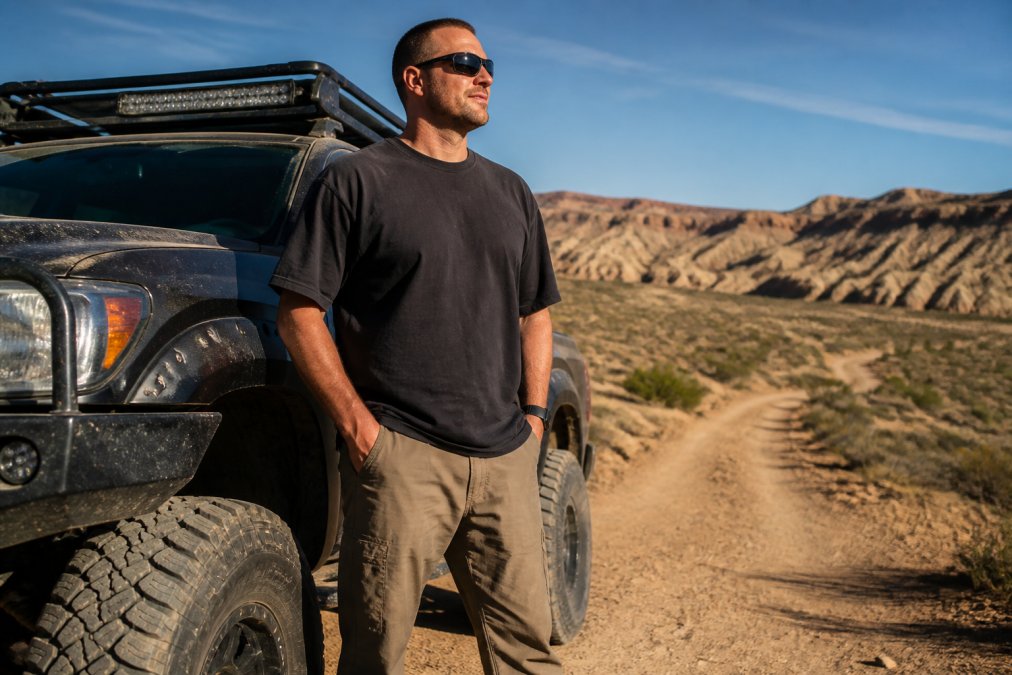
The Trail Explorer crafts custom clothing and apparel specifically for off-road enthusiasts and trail lovers, offering premium heavyweight tees and headwear that capture the spirit of adventure. We provide comfortable, high-quality garments with unique designs focused on rock crawling and trail exploration, allowing you to express your passion for the great outdoors and side-by-side riding with every wear. Our collection ensures you look good and feel great, whether you're conquering new trails or simply showcasing your adventurous lifestyle. The men's premium heavyweight tee runs from S through 4XL, with a 3XL measuring 28 inches wide and 34.5 inches long. That length matters for tall drivers, it stays tucked or sits cleanly at the hip when you're in and out of a cab all day. The 6.5 oz/yd² ring-spun cotton holds its structure through a full season of trail use.

For drivers with a longer torso, the Men's premium heavyweight tee The Trail Explorer at $28.25 is the practical starting point. If you're on the trail in cooler conditions, the Men's heavyweight long sleeve t-shirt Take the Trail Less Traveled at $27.50 uses the same 6.5 oz ring-spun cotton with sleeve length that works for longer arms.
For colder days at camp or early morning trail starts, the Oversized heavyweight hoodie Make Rock Crawling Great Again at $55.00 runs intentionally large with a 10 oz/yd² brushed fleece interior. The roomy, unisex fit means tall guys with broader builds aren't fighting the fabric.
The designs are built around rock crawling and trail culture specifically. According to sizing and fit research from the American Society for Testing and Materials apparel standards, standardized apparel sizing in the US still underrepresents tall and long-torso body proportions across most clothing categories, which is why purpose-built sizing ranges matter for this demographic.
Finding the right fit as a tall off-roader means solving two separate problems: the vehicle cockpit and the gear you wear into it. Both reward the same approach: start with accurate measurements, know which adjustments are available to you, and don't settle for "close enough" when specific solutions exist. The Trail Explorer's heavyweight tee lineup is built for drivers who actually use their gear on the trail, with sizing that runs tall and construction that holds up to serious use. Subscribe to our emails for new designs, sizing guides, and gear drops built for the off-road community.
Frequently Asked Questions
Q: What is the best driving position for tall people in off-road vehicles?
A: Tall drivers should set the seat as far back as seat travel allows, then raise the hip point so thighs angle slightly downward rather than pressing flat against the cushion. Adjust the steering column to full telescoping extension and maximum rake so arms have a slight bend at roughly 90 degrees. On rough terrain, this seating position reduces driver fatigue and keeps you in control without cramping the lower back or knees against the dash.
Q: Are there specific seat adjustments that improve comfort for tall drivers on trails?
A: Yes. Tall driver seat adjustments for off-roading go beyond sliding the seat back. Aftermarket seat rail extensions add 1 to 3 inches of rearward travel that stock rails don't offer. Swapping to a low-profile seat base drops the hip point and recovers vertical clearance. Adding lumbar support inserts or a seat with adjustable thigh support extension prevents the hip fatigue that builds up on long overlanding runs or rocky trails.
Q: How does a sunroof affect headroom for tall off-roaders?
A: A panoramic or moonroof module typically reduces interior headroom by 1 to 2 inches because the housing and track mechanism sit inside the roofline. For a driver who already has less than 2 inches of vertical clearance, that loss is significant, especially when wearing a helmet for off-road racing or trail use. If helmet clearance is a priority, opt for a trim level without a sunroof or confirm headroom specs against the helmeted measurement before buying.
Q: What should tall off-roaders look for in heavyweight trail apparel?
A: Tall frames need a tee with enough body length to stay tucked or cover the waistband through full arm extension and twisting movements. Look for garments sized with both width and length measurements listed. Heavyweight apparel for tall outdoor enthusiasts, like The Trail Explorer's 6.5 oz ring-spun cotton tees, uses structured side-seamed construction that holds shape after repeated washes without riding up during active use on the trail.
This article was written using GrandRanker