

Table of Contents
- Why Riders Are Looking for an Offroadlife Alternative
- Best Off-Road Apparel Brands Built for the Trail
- Cons:
- Durable Clothing for Rock Crawling: What Survives the Trail
- Side-by-Side Riding Gear Essentials for Every Season
- Budget-Friendly vs Premium Trail Gear: Where to Spend
- How to Spot Trail Gear That Will Fail on the Trail
- Conclusion
- Frequently Asked Questions
Last Updated: September 10, 2026
Why Riders Are Looking for an Offroadlife Alternative
Riders search for an Offroadlife alternative for trail gear because heritage workwear labels build for job sites, not rock crawling culture. The Trail Explorer fills that gap with custom apparel for people who read a trail map the way other folks read a menu.
Carhartt and similar brands build for durability first and identity second, fine for framing a house, less so when you want a heavyweight tee that survives a weekend at Moab and still looks like it belongs to someone who actually wheels. The trail gear market has split into generic workwear and loud graphic shirts that fade after three washes. Neither serves the rider who wants both.
You do not have to choose between clothing that lasts and clothing that means something.
Best Off-Road Apparel Brands Built for the Trail
The best off-road apparel brands combine three things: fabric weight that survives abrasion, construction that holds its shape after repeated washing, and designs that signal trail culture rather than generic outdoorsmanship. Most brands nail one. Very few nail all three.
The brand builds around rock crawling and trail exploration, not a broad "adventure" aesthetic that could just as easily sell you a kayak. The lineup runs from a $25 classic tee to a $96 Columbia fleece jacket.
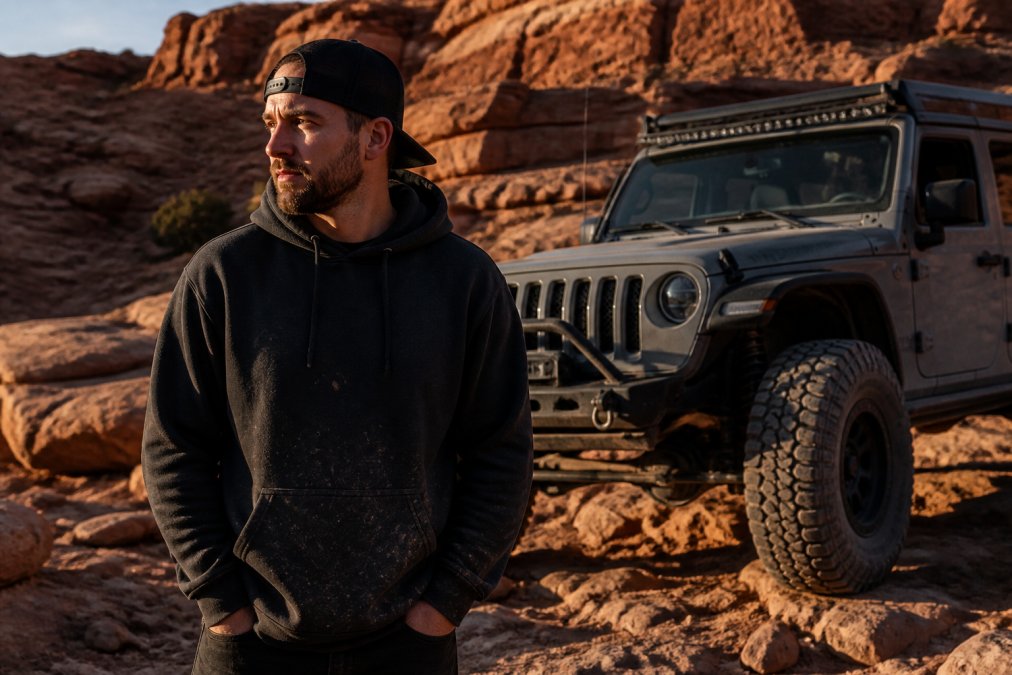
The Trail Explorer: Purpose-Built for Rock Crawling Culture
The Oversized Heavyweight Hoodie is the clearest example: a 10 oz./yd² brushed fleece blend, roughly double a standard hoodie, with a roomy unisex cut and a double-layered hood with no drawcords to snag on a roll cage or branch. The Men's Heavyweight Long Sleeve Tee follows the same logic: 6.5 oz./yd² combed ring-spun cotton, side-seamed construction, and a ribbed collar with Lycra so it does not stretch out after a season of hard use.

For colder trail days, the Unisex Columbia Fleece Jacket at $96 layers under a shell without adding bulk, and the Neck Gaiter at $25 handles dust, wind, and sun. Headwear rounds it out: the Garment Washed Baseball Cap and the Distressed Dad Hat both sit at $25 to $30 and look broken-in from day one.
Pros:
- Designs built around rock crawling and trail culture, not generic outdoors
- Heavyweight fabric options that hold up to real trail abuse
Cons:
- Higher price point than mass-market graphic tees
Durable Clothing for Rock Crawling: What Survives the Trail
Durable clothing for rock crawling comes down to fabric weight, stitch density, and abrasion resistance against rock, brush, and seat bolsters. Anything under about 5 oz./yd² is a costume, not gear.
Here is the part most guides skip: the failure point on trail apparel is rarely the fabric itself, but the seams and the collar. A shirt can have a bombproof body and still fall apart because the collar stretched out or the shoulder seam blew. Construction details matter more than the hang tag copy.
Fabric Weight and Construction That Actually Lasts
Fabric weight is measured in ounces per square yard and tells you how much material you are actually getting. A 5.0 to 5.3 oz./yd² tee is standard-weight cotton, a 6.5 oz./yd² long sleeve is a step up, and a 10 oz./yd² fleece hoodie is genuinely heavy gear.

What to check before you buy:
- Fabric weight listed in oz./yd², not vague terms like "premium"
- Side-seamed construction rather than tubular, which holds shape better
- Ribbed collar with spandex or Lycra to resist stretching
- Double-needle stitching at stress points like shoulders and hem
- Pre-shrunk fabric if you plan to wash it in hot water
Side-by-Side Riding Gear Essentials for Every Season
Side-by-side riding gear essentials change with the season, but the core layering system stays the same: a base layer, a mid layer, and a shell. On a side-by-side that is a safety and comfort system, not just a clothing question, because you are exposed to wind, dust, and radiant heat from the engine and exhaust in a way a closed-cab driver never is.
The Three-Layer System, Translated for Open-Cab Riding
A base layer manages moisture, a mid layer traps heat, and a shell blocks wind and light precipitation (rei.com). On a side-by-side, add a fourth job: abrasion and dust protection for the parts of you that face forward.
- Base layer: A heavyweight long sleeve in the 6.5 oz./yd² range works for three seasons. It wicks less than a synthetic but resists abrasion from the seat belt and shoulder harness far better, and it does not melt against a hot exhaust shield the way some synthetics can.
- Mid layer: A fleece jacket in the 8 to 10 oz. range adds warmth without bulk under a harness. The Unisex Columbia Fleece Jacket at $96 fits this slot.
- Shell: A packable windbreaker or softshell blocks the wind that hits you at 30 mph on an open trail, the layer most riders skip and then regret on a ridge line.
- Accessory layer: A neck gaiter handles dust, sun, and cold in one piece. The Neck Gaiter at $25 is the highest-value accessory in the system because it covers the gap between helmet and collar where dust and wind get in.
Season-by-Season Build
| Season | Base Layer | Mid Layer | Shell / Outer | Accessory |
|---|---|---|---|---|
| Summer | Classic tee, 5.0 oz. | None | None | Neck Gaiter, baseball cap |
| Fall | Heavyweight long sleeve, 6.5 oz. | Fleece jacket | Packable windbreaker | Baseball cap, gaiter |
| Winter | Heavyweight long sleeve | Oversized hoodie, 10 oz. | Fleece jacket + shell | Gaiter, dad hat under helmet |
| Spring | Classic tee | Hoodie | Windbreaker | Dad hat, gaiter |
What Field Testing Reveals About Layering
A common pattern in forum reports and owner logs is that the failure point in a layering system is almost never the outer layer, it is the base layer. One that fits too tight restricts shoulder rotation behind the wheel; one that fits too loose bunches under a harness and creates a pressure point. Size up if you are between sizes, especially on a heavyweight long sleeve.

The second most common failure is the transition zone at the neck and wrists, where wind, dust, and cold enter the system. A gaiter and a long enough sleeve solve it; a short-sleeve tee and an open collar do not, no matter how heavy the fabric is.
The Repairability Angle Most Gear Lists Skip
Serious overlanders increasingly favor gear that can be repaired in the field rather than replaced. A small sewing kit with a heavy-duty needle, waxed thread, and a few spare buttons turns a blown seam from a trip-ending problem into a 10-minute fix (nps.gov). Cotton and cotton-blend trail apparel takes a field repair far better than technical synthetics, which is one reason heavyweight cotton remains common in rock crawling culture even as the rest of the outdoor market moves to synthetics.
When you build a seasonal kit, ask one question about each piece: if this fails on the trail, can I fix it with what is in my tool bag? If not, it is a weak link.
Budget-Friendly vs Premium Trail Gear: Where to Spend
Budget-friendly trail gear and premium trail gear differ most in fabric weight, construction detail, and how many seasons the garment survives. The real question is which pieces justify the premium, and that answer comes from understanding how gear actually fails.
The Longevity and Failure Analysis Most Guides Avoid
Most content tells you what to buy; very little tells you why things break. That gap matters because the cost of a piece of trail gear is not the sticker price, it is the sticker price divided by the seasons it survives.
Trail apparel fails in four predictable ways:
- Fabric abrasion: The body thins against rock, brush, and seat bolsters until it tears. Heavier fabric delays this only if the yarn is tightly knit, a loose open-end yarn at 6 oz. can fail faster than a tightly knit 5 oz. fabric because the fibers pull out of the weave.
- Seam failure: Stitching pulls apart at the shoulder, armhole, and hem. This is a construction problem, not a fabric problem. Double-needle stitching at stress points is the tell.
- Collar stretch: A ribbed collar without spandex or Lycra relaxes over a season and stops holding shape. This is the most common cosmetic failure and the hardest to repair.
- Print cracking: A thick plastisol print on a loosely knit shirt cracks and peels. A thinner print on a tightly knit surface flexes with the fabric and lasts far longer.
Understanding these four failure modes tells you where the premium is worth paying. You are not buying a logo. You are buying more yarn, denser stitching, and a better knit surface.
Where the Premium Pays Off
- Base layers and tees worn against your skin every trip. These take the most wash cycles and abrasion. A $25 classic tee that survives three seasons beats a $12 tee that survives one.
- Anything that rubs against a seat belt or harness. The shoulder and chest panels of a long sleeve are the highest-wear zones on the garment.
- Cold-weather mid layers. A fleece that holds loft after repeated washing is worth more than one that pills and flattens.
- Pieces with published fabric weights and construction specs. If the brand tells you the oz./yd² and stitch type, you can predict how it will fail. If not, you are guessing.
Where to Save
- Accessories you might lose on the trail. A $25 gaiter is easy to replace. Do not overpay for a piece that lives in a pocket.
- Second and third colorways. One proven piece beats three unproven ones.
- Meetup-only apparel. If it never sees dust, it does not need trail-grade construction.
How the Pricing Actually Breaks Down
A $25 classic tee is not a budget throwaway, and a $96 fleece jacket is not a luxury splurge. Coming from generic sporting goods brands, expect heavier fabric and a roomier fit.
Compare cost per season, not cost per item. A $25 tee worn 40 times a year for three seasons costs about 21 cents per wear; a $12 tee worn 40 times a year for one season costs 30 cents per wear. The cheaper shirt is the more expensive one.
The Repairability Premium
There is a second kind of value that does not show up on the price tag: how well a piece takes a field repair. Heavyweight cotton and cotton-blend apparel can be patched, re-stitched, and reinforced with a basic sewing kit. Many technical synthetics cannot be repaired in the field at all, because a patch will not bond without heat or specialized adhesive. For overlanders who measure value in seasons, repairability is worth paying for even at a higher sticker price.
How to Spot Trail Gear That Will Fail on the Trail
Trail gear that will fail usually gives you warning signs first. Learning to read them saves you a mid-season replacement and a cold ride home.
Watch for these red flags:
- Fabric weight not listed anywhere on the product page
- Collars that feel flimsy or stretch when you pull them over your head
- Single-stitched hems on a garment marketed as "heavy duty"
- Prints that feel like a thick plastic patch, which crack and peel
- No size chart with actual measurements, only S/M/L
Then there is the longevity question most gear guides avoid. A shirt fails in one of three ways: the fabric thins and tears, the seams pull apart, or the print fades and cracks. Fabric and seam failure are construction problems; print failure is a decoration problem, which is why tightly knit fabric matters, it holds a print better than a loose open-end yarn, one reason the Men's Heavyweight Long Sleeve Tee uses a tightly knit fabric specifically for printability.
Conclusion
The real challenge with trail gear is not finding clothing that looks the part, but apparel that survives the trail and still says something about who you are as a rider. Most brands make you pick one or the other.
The Trail Explorer exists to close that gap, building heavyweight tees, hoodies, and headwear specifically for rock crawling and trail culture, with published fabric weights and construction details you can verify. Start with a heavyweight tee or the Oversized Heavyweight Hoodie, wear it for a season, and see how it holds up. Subscribe to The Trail Explorer's emails to hear about new designs and restocks before they sell out.
Frequently Asked Questions
What are the best brands for off-road lifestyle apparel?
The best off-road apparel brands combine durable materials with designs that reflect trail culture. Look for heavyweight cotton, ring-spun blends, and reinforced stitching. The Trail Explorer offers premium heavyweight tees, hoodies, and headwear designed specifically for rock crawling and trail exploration. Their unisex classic tee ($25) and oversized heavyweight hoodie ($87.18) are built to handle trail abuse while showing off your off-road passion.
How do I choose high-quality clothing for rock crawling?
Focus on fabric weight and construction. Heavyweight options like 10 oz./yd² fleece or 6.5 oz./yd² ring-spun cotton hold up better against abrasion from rocks, branches, and vehicle contact. Check for double-needle stitching at stress points and pre-shrunk fabrics to avoid fit issues after washing. The Trail Explorer's men's heavyweight long-sleeve tee ($35) uses 100% combed ring-spun cotton with a tightly knit surface that resists snags and fading.
What should I look for in durable off-road trail gear?
Prioritize fabric weight, stitch quality, and fit. Heavier fabrics (6.5 oz./yd² and up) resist tearing better than lightweight alternatives. Look for double-stitched seams at shoulders, cuffs, and hems. Pre-shrunk materials prevent surprise shrinkage. For layering, a fleece jacket like The Trail Explorer's Columbia fleece ($96) adds warmth without bulk. Always check size charts since some premium items run small and may need sizing up.
Are there better alternatives to mainstream off-road clothing brands?
Yes. While mainstream brands offer broad outdoor coverage, niche brands like The Trail Explorer focus specifically on off-road and rock crawling culture. That means designs that speak to trail riders rather than generic outdoor enthusiasts. You get premium heavyweight materials and styles ranging from bold graphics to subtle trail-themed prints. Prices start at $25 for tees and go up to $96 for fleece jackets.
Where can I find unique apparel for side-by-side riding?
Specialty off-road apparel shops and direct-to-consumer brands are your best bet. The Trail Explorer carries designs inspired by trails like Hells Revenge in Moab, Utah, including garment-washed caps ($25) and distressed dad hats ($29.75). Their neck gaiter ($25) works as a face covering, headband, or neck warmer for dusty side-by-side rides. Shopping directly from enthusiast-focused brands gets you gear that matches the culture, not just the activity.