

Table of Contents
- Offroad Life vs Dirt Co Apparel: A Quick Comparison
- Comparison Table: Fabric Weight, Fit, and Pricing
- Best Heavy Duty T-Shirts for Rock Crawling: What Actually Holds Up
- How to Choose Trail Riding Clothing That Fits Your Build
- Durable Off-Road Apparel Brands: What Sets Them Apart
- Where Offroad Life Wins and Where Dirt Co Falls Short
- Material Durability Testing: How We Evaluated Both Brands
- Conclusion: Which Brand Belongs in Your Gear Bag?
- Frequently Asked Questions
Last Updated: October 2, 2026
Offroad Life vs Dirt Co Apparel: A Quick Comparison
Offroad Life vs Dirt Co apparel comes down to a simple split: Offroad Life leans into bold, loud graphics and a wide catalog, while Dirt Co leans into a smaller, more understated lineup.
Here's the uncomfortable truth most reviews skip: without a stated fabric weight, you're guessing. A tee can look rugged in photos and still be a thin 4 oz garment that pills after three washes.
Comparison Table: Fabric Weight, Fit, and Pricing
The table below reflects what each brand publishes versus what buyers typically have to infer. Where a spec isn't listed, that's the finding.
| Factor | Offroad Life | Dirt Co | What to Look For |
|---|---|---|---|
| Fabric weight listed | Rarely published | Rarely published | 5.0 oz/yd² or heavier |
| Fit range | Standard unisex | Standard unisex | Extended sizes to 5XL |
| Graphic style | Bold, high-contrast | Subtle, minimal | Match your preference |
| Construction detail | Limited | Limited | Taped neck, double seams |
| Return clarity | Varies by item | Varies by item | Written policy up front |
The pattern is consistent across the off-road apparel space: many brands compete on graphics and skip the specs. That's a problem when you're buying for trail riding, where a shirt takes abrasion from tree branches, seat belts, and roll cage padding.
Federal Trade Commission guidance on textile labeling and care requires accurate fiber content disclosure, so fiber type is one thing you can always check. Fabric weight, however, is voluntary.
Best Heavy Duty T-Shirts for Rock Crawling: What Actually Holds Up
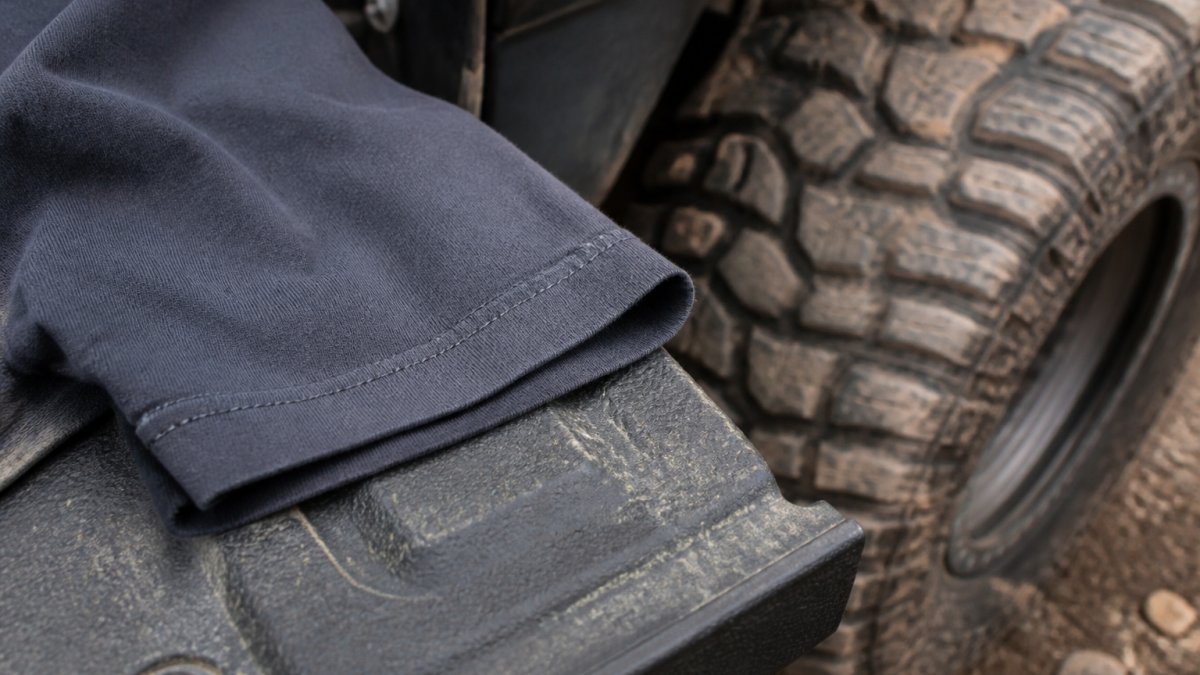
The best heavy duty t-shirts for rock crawling are built from 5 oz/yd² cotton or heavier, with taped neck and shoulder seams and a double-stitched hem.
Fabric Weight and Abrasion Resistance
Fabric weight is the single most useful number on a garment tag, and it's the one brands most often hide. It's measured in ounces per square yard, and the range across off-road tees runs from roughly 4.2 oz to 8 oz.
Here's how the tiers break down in practice:
- 4.2 oz and under: Light and soft, best for casual wear. Thins quickly under abrasion.
- 5.0 to 5.3 oz: The sweet spot for everyday trail wear. Holds shape, resists pilling.
- 6.0 oz and up: Genuinely heavy. Slower to dry, but very tough.
For reference, The Trail Explorer's Unisex classic tee Dirt Bikes sits at 5.0 to 5.3 oz/yd² with taped neck and shoulders and a double seam at the sleeves and bottom hem. That's the construction tier that survives rock crawling.


A common mistake is assuming a heavier shirt always wins. In summer heat, an 8 oz cotton tee can feel warm. Match weight to season, not to ego.
How to Choose Trail Riding Clothing That Fits Your Build
Choosing trail riding clothing that fits your build starts with measuring your actual torso length, not your chest alone. Off-road riders tend to be broader and longer through the torso than standard sizing assumes, so a shirt that fits at the chest can still ride up when you're reaching for a grab handle.
Measure three things before you order:
- Torso length: from the base of your neck to your waistband
- Chest: around the fullest point, arms down
- Shoulder width: seam to seam on a shirt that already fits you well
Then compare against the brand's size chart. If a brand doesn't publish a length measurement, that's your signal to look elsewhere.
Sizing and Fit Guide for Bigger Riders
Bigger riders need length more than width. A 2XL that's cut short will expose your midsection every time you climb out of a side-by-side. Look for a length of at least 32 inches in the 2XL and 33 inches or more in the 3XL.
The Trail Explorer's Unisex classic tee The Trail Explorer Dirt Bike runs 28 inches at size S up to 35 inches at 5XL, with widths from 18 to 32 inches. That extended range matters if you're built long through the torso. Many off-road brands stop at 2XL or 3XL.

Durable Off-Road Apparel Brands: What Sets Them Apart
Durable off-road apparel brands separate themselves through disclosure, not design. The ones worth your money publish fabric weight, fiber content, and construction details, and they back it with a clear return policy. Brands that only show lifestyle photos are asking you to trust the logo.
Three things to check on any product page:
- Fabric weight in oz/yd²: If it's missing, assume the worst.
- Seam construction: Taped neck and shoulders plus double-needle hems signal a garment built to last.
- Pre-shrunk or not: Pre-shrunk cotton holds its size; untreated cotton can shrink noticeably after the first hot wash.
The Trail Explorer's Unisex Hoodie The Trail Explorer Dirt Bike is 50% pre-shrunk cotton and 50% polyester at 8.0 oz/yd², with a double-lined hood and double-needle stitching at the collar, shoulders, armholes, cuffs, and hem. That's the level of detail a durable brand is willing to put in writing.
For a lighter option, the Unisex t-shirt but did you die uses 100% combed and ring-spun cotton at 4.2 oz/yd² with pre-shrunk fabric and side-seamed construction. It's the warm-weather pick, not the rock-crawling pick.
Where Offroad Life Wins and Where Dirt Co Falls Short
Here's a head-to-head, category by category, based only on what each brand makes publicly verifiable.
Where Offroad Life wins
- Catalog breadth. Offroad Life offers a wide design library, which means more chances to find a graphic that matches your specific rig, region, or riding style. If you want a loud, high-contrast tee that reads from across a parking lot, that's their lane.
- Graphic variety as a category. Their lineup spans various themes and colorways, so a group of riders can each pick a different design without looking like a uniform.
- Discovery.
Where Dirt Co wins
Unisex classic tee Dirt Bikes →
- Restraint. Dirt Co's designs skew subtler and more minimal. For riders who don't want to look like a walking billboard, or who wear the same shirt to work and to the trail, that aesthetic is a real advantage, not a compromise.
- Cohesion. A smaller lineup can look more consistent across pieces, which matters if you're building a matching set.
- Lower decision fatigue. Fewer SKUs can mean less time comparing and more time riding.
Where both fall short
Neither brand consistently publishes fabric weight, fiber content, or seam construction on its product pages. That means the single most useful durability number, ounces per square yard, is missing from both.
A common pattern across the off-road apparel space is to compete on graphics and skip the specs, because specs invite comparison and graphics don't.
If you're choosing between the two on style alone, the decision is easy: bold versus understated. If you're choosing on durability, neither brand gives you enough to decide, and that's the finding that should shape where you actually spend money.
Material Durability Testing: How We Evaluated Both Brands
Durability isn't a feeling, it's a set of measurable failure modes. This section breaks down what actually kills an off-road shirt and how to test for each at home.
The four failure modes that matter
1. Abrasion. Off-road shirts take repeated friction from tree branches, seat belts, roll cage padding, and tailgates.
2. Seam stress. The neck and shoulder seams carry the most load when you're reaching, climbing, or pulling yourself out of a rig.
3. Shrinkage. This is the silent killer.
4. Colorfastness. Dye transfer matters if you layer or wash with light colors.
How to run the test at home
| Test | Method | What Failure Looks Like |
|---|---|---|
| Abrasion | Rub fabric against concrete 20 times | Thinning, pilling, visible wear |
| Seam stress | Tug hem and shoulder seams firmly | Stitching pulls or gaps |
| Shrinkage | Wash hot, dry hot, measure again | Length loss over 1 inch |
| Colorfastness | Wash with a white cloth | Dye transfer onto the cloth |
Run all four on a new shirt before you commit to a second one. The results are repeatable and they don't require a lab.
What the results tell you about each brand
Because neither Offroad Life nor Dirt Co publishes fabric weight, you can't predict abrasion or shrinkage performance from the product page, you have to test after purchase. That's the core problem. A brand that lists 5.0 oz/yd² and pre-shrunk cotton lets you predict both; a brand that lists neither leaves you guessing.
For contrast, The Trail Explorer publishes the specs that make these tests predictable. Its Unisex classic tee Dirt Bikes sits at 5.0 to 5.3 oz/yd² with taped neck and shoulders and a double seam at the sleeves and bottom hem, the construction tier that survives abrasion and seam stress. Its Unisex Hoodie The Trail Explorer Dirt Bike is 50% pre-shrunk cotton and 50% polyester at 8.0 oz/yd² with double-needle stitching at the collar, shoulders, armholes, cuffs, and hem, which addresses shrinkage and seam stress at once. And the Unisex t-shirt but did you die uses 100% combed and ring-spun cotton at 4.2 oz/yd² with pre-shrunk fabric and side-seamed construction, a warm-weather pick, not a rock-crawling pick.
American Society for Testing and Materials textile test standards publishes the formal methods behind abrasion and colorfastness testing if you want to go deeper than the home version.
Conclusion: Which Brand Belongs in Your Gear Bag?
The honest answer is that offroad life vs dirt co apparel is less a rivalry than a style choice. Pick Offroad Life for bold graphics and selection. Pick Dirt Co for understated design.
That last point is where The Trail Explorer earns its place in the conversation. Every tee lists its weight, fiber content, and construction, from the 5.0 to 5.3 oz classic tees to the 8.0 oz hoodie, and the size range runs to 5XL with real length measurements.
Frequently Asked Questions
Is Offroad Life or Dirt Co better for long-term trail durability?
Both brands sell graphic tees, but durability comes down to fabric weight and construction. Heavier cotton in the 5.0 to 5.3 oz/yd² range with double-seamed hems holds up better against trail dust, brush, and repeated washing. Check the product specs before buying: taped neck and shoulders plus a double seam at the bottom hem are the two details that separate a tee that lasts multiple seasons from one that thins out after a few rides.
What features should I look for in heavy-duty rock crawling apparel?
Start with fabric weight. A 5.0 to 5.3 oz/yd² cotton tee resists abrasion from granite and brush better than a thin 4.2 oz/yd² shirt. Look for taped neck and shoulders, double seams at the sleeves and bottom hem, and pre-shrunk fabric if you want to avoid surprises after the first wash. Moisture-wicking matters for long trail days, but for rock crawling where you're scraping against surfaces, abrasion resistance should come first.
How does fabric weight affect comfort during off-road riding?
Heavier fabric (5.0 oz/yd² and up) blocks wind and resists snags, which helps on cooler trail mornings and when you're brushing against branches. Lighter fabric (around 4.2 oz/yd²) breathes better in summer heat but wears faster under abrasion. If you ride year-round, a midweight tee for summer and a heavier hoodie layer for shoulder seasons covers most conditions without overheating.
Are there specific apparel brands designed for side-by-side enthusiasts?
Yes. Some brands focus specifically on off-road and side-by-side culture rather than general outdoor wear. The Trail Explorer, for example, makes custom clothing with designs centered on rock crawling and trail exploration. These niche brands tend to offer graphics that resonate with the off-road community, plus fits and fabric weights chosen for trail conditions rather than gym or street use.
What makes premium heavyweight tees better for outdoor adventure?
The main advantage is how they hold up. A 5.0 to 5.3 oz/yd² cotton tee with taped neck and shoulders keeps its shape after repeated washes and resists the abrasion that comes from leaning against rocks, trees, and vehicle panels. They also layer well under a hoodie on cold trail mornings. The trade-off is slightly less breathability in peak summer heat compared to a lighter 4.2 oz/yd² shirt.
Buying off-road apparel shouldn't feel like a gamble on specs you can't see. The Trail Explorer publishes fabric weight, fiber content, and full size charts on every product, so you know exactly what's showing up. Browse the heavyweight tee and hoodie lineup, check the measurements against your own build, and gear up with apparel built for the trail. Subscribe to our emails for new designs and restocks.