

Table of Contents
- Dirtco vs Goatstrail: Moisture-Wicking Trail Gear Comparison Table
- Best Moisture-Wicking Shirts for Off-Roading
- Essential Gear for Long-Distance Trail Rides
- How to Choose Trail Riding Clothing
- Where Dirtco and Goatstrail Fall Short
- Verdict: Is Dirtco or Goatstrail Better for High-Quality Moisture-Wicking Gear?
- Frequently Asked Questions
Last Updated: September 29, 2026
Dirtco vs Goatstrail: Moisture-Wicking Trail Gear Comparison Table
Search for whether Dirtco or Goatstrail is better for moisture-wicking gear for long trail rides, and you'll find opinions but little technical detail, most comparisons rank logos instead of fabrics. This guide breaks down what actually keeps you dry: the materials, the fit issues that cause chafing, and the layering system long rides require.
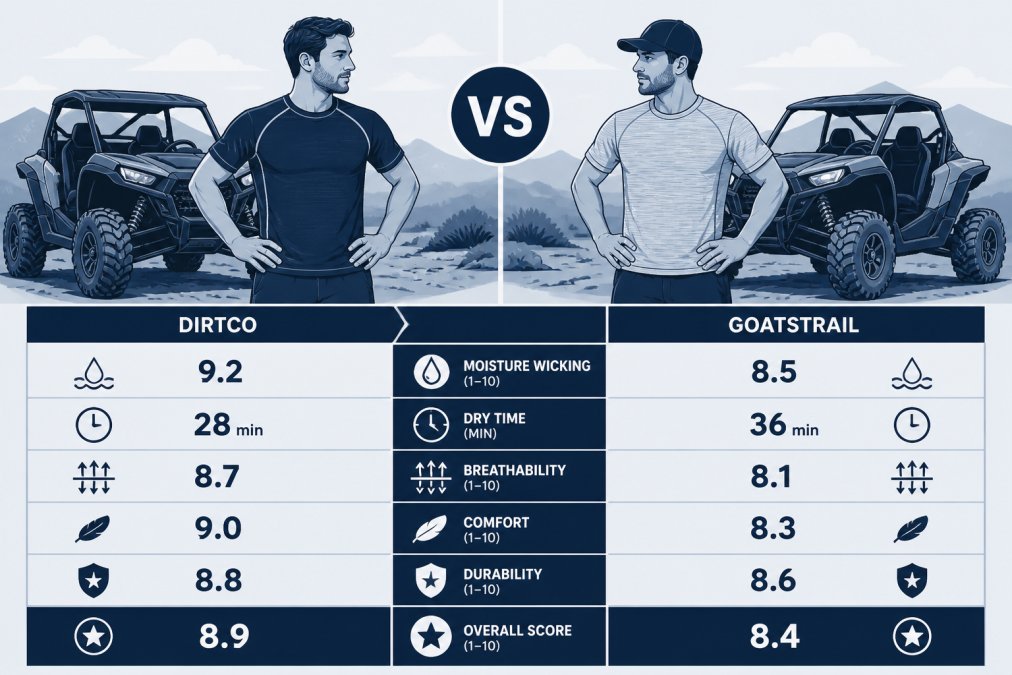
| Feature | Dirtco | Goatstrail | What Actually Matters |
|---|---|---|---|
| Primary focus | Off-road lifestyle apparel | Trail and riding apparel | Fabric spec over branding |
| Moisture-wicking claims | Marketing-level | Marketing-level | Look for fiber content, not slogans |
| Fabric detail published | Limited | Limited | Weight and blend drive performance |
| Fit range | Standard sizing | Standard sizing | Torso length and chest cut |
| Best for | Casual trail wear | Casual trail wear | Long rides need technical layers |
Best Moisture-Wicking Shirts for Off-Roading
The best moisture-wicking shirts for off-roading combine a synthetic-dominant blend, a relaxed cut that allows airflow, and a fabric weight matched to your climate. Cotton-heavy shirts hold sweat against your skin; polyester and spandex blends move it away and dry fast. What most gear lists skip is why one synthetic shirt outperforms another on hour five of a ride, the answer lives in fiber chemistry, knit structure, and fabric weight, not the brand name.
Fabric Technology and Moisture Transport
Moisture transport works through capillary action: synthetic fibers pull sweat from your skin to the fabric surface, where it evaporates. Polyester absorbs almost no water, so moisture travels along the fiber surface and the fabric stays light, while cotton's cellulose structure bonds with water molecules, a soaked cotton tee holds several times its own weight in sweat and stops drying once saturated.
- Fiber shape and denier. Engineered cross-sections ("channeled" or "profiled" fibers) create more surface area and capillary pathways than standard round filaments, speeding transport. Finer denier feels softer but mats down under a hydration pack strap; coarser denier resists compression and keeps airflow channels open.
- Knit structure. Mesh or bird's-eye knits expose more surface area to moving air than flat jersey, so 100% polyester mesh dries noticeably faster in sun and wind. Denser interlock trades dry speed for durability against a side-by-side seat and roll cage.
- Fabric weight. Measured in ounces per square yard (oz./yd.²), weight drives the trade-off between comfort at rest and performance under load. Lighter fabrics (roughly 4-5 oz./yd.²) ventilate and dry fastest in heat; mid-weight knits (roughly 6-8 oz./yd.²) feel better on cool mornings and hold up longer against abrasion.
Fit, Sizing, and Long-Ride Ergonomics
- Body length vs. seated posture. Sitting in a side-by-side or leaning forward on a trail bike compresses your torso and rides your shirt up. Two extra inches of body length stays put; a standard-length tee exposes your lower back to sun, dust, and harness or seat-belt chafing.
- Side seams and split hems. A straight hem bunches at the waist when seated, creating a fold that traps heat and rubs. A split hem lets front and back panels move independently, and side seams keep the shirt from rotating as you shift weight.
- Chest and shoulder cut. A relaxed cut allows air to circulate between fabric and skin, which is what actually carries evaporated moisture away. A tight cut eliminates that air gap and turns the shirt into a second skin that can't vent.
When you compare shirts, put the specs side by side: fiber content and weight tell you how fast it dries, and body length plus hem construction tell you whether it stays in place. A 4.13 oz./yd.² polyester mesh with an extended split hem will outperform a 7.41 oz./yd.² cotton blend on a hot, long ride, not because one brand is better, but because the specs match the conditions.
Essential Gear for Long-Distance Trail Rides
Essential gear for long-distance trail rides is a layering system, not a single shirt: a moisture-wicking base layer, a breathable mid layer, and headwear that manages sweat without trapping heat.
Build it in three parts:
- Base layer: a synthetic or blended quick-dry shirt against your skin, matched to the day's temperature. Lightweight mesh for heat, heavier blend for cool mornings.
- Mid layer: a breathable layer you can shed when the trail opens up and the sun hits, then pull back on for shaded sections.
- Headwear: a low-profile visor or cap that keeps sweat and glare out of your eyes without adding heat. The Visor The Trail Explorer uses a 97% polyester, 3% spandex blend with a matching undervisor and a hook-and-loop closure, and its low 2.5-inch crown keeps it from trapping heat on long days.
How to Choose Trail Riding Clothing
To choose trail riding clothing, match three variables: fabric blend, fit, and the conditions you actually ride in. Get those right and brand loyalty becomes secondary.

Start with a short checklist:
Under ArmourⓇ athletic t-shirt →
- Confirm the fiber content: synthetic or synthetic-blend for the base layer, not cotton-dominant
- Check the fabric weight against your climate (lighter for heat, heavier for cool mornings)
- Verify body length and chest measurements, not just S/M/L
- Look for side seams and split hems that reduce bunching while seated
- Match headwear to ventilation needs, not just style
Where Dirtco and Goatstrail Fall Short
Both Dirtco and Goatstrail fall short in the same area: published fabric detail. Neither makes it easy to compare fiber content, fabric weight, or body length across their line, the specs that decide how a shirt performs on hour five of a ride. "They don't publish specs" is only useful if you know which specs to demand.
- Fiber content by percentage. The Federal Trade Commission guidance on textile fiber labeling requires fiber content to be disclosed on the label, so the information exists, it's just rarely surfaced in online product listings. If a listing shows only "moisture-wicking fabric" without percentages, you're reading marketing, not a spec.
- Fabric weight in oz./yd.². The single best predictor of dry time and breathability, almost never published outside technical base-layer brands. Without it, you can't compare a 4 oz. mesh to an 8 oz. knit.
- Body length and chest measurements in inches. S/M/L tells you almost nothing about whether a shirt stays tucked when you're seated, a 29-inch and a 32-inch body length can both be labeled "large."
- Knit structure and hem construction. Mesh vs. jersey knit, split hem vs. straight hem, side-seamed vs. tubular, these determine airflow and whether the shirt twists or bunches on a long ride.
Verdict: Is Dirtco or Goatstrail Better for High-Quality Moisture-Wicking Gear?
For high-quality moisture-wicking gear for long trail rides, neither Dirtco nor Goatstrail clearly wins on published technical merit. Both sit in the lifestyle-apparel tier, with limited fabric transparency and standard sizing.
- If you want maximum ventilation in heat: prioritize 100% polyester mesh pieces over cotton blends.
- If you ride cool mornings and want comfort at rest: a heavier cotton-poly blend works well as a base layer.
- If you have a longer torso or a bigger build: check body length and chest measurements before anything else.
- If you ride long distances regularly: build a three-part layering system rather than buying one "do-everything" shirt.
Frequently Asked Questions
What features should I look for in moisture-wicking off-road apparel?
Look for synthetic fabrics like polyester that pull sweat away from your skin, plus ventilation panels or mesh zones. A relaxed fit with extended length helps prevent chafing when you're seated for hours. Check for quick-dry properties and flatlock seams. The Under Armour Cliffhanger tee uses a 60% cotton, 40% polyester blend that balances softness with moisture management, while the Unisex Sports Jersey is 100% breathable polyester mesh for maximum airflow.
Does Dirt Co. offer specialized gear for long-distance trail riding?
Dirt Co. offers some moisture-wicking shirts, but their lineup focuses more on casual off-road apparel than technical trail gear. For long-distance rides, you need pieces designed for sustained moisture transport and chafe prevention. The Trail Explorer's Unisex Sports Jersey, with its 100% breathable polyester mesh and extended length, is built for all-day comfort on the trail. Always verify fabric weight and ventilation before buying for 4+ hour rides.
How does heavy-duty trail apparel compare to standard moisture-wicking fabrics?
Heavy-duty trail apparel often uses thicker, abrasion-resistant fabrics that prioritize durability over breathability. Standard moisture-wicking fabrics are lighter and dry faster but may wear out quicker. The Under Armour Cliffhanger tee weighs 7.41 oz./yd.², making it a middle ground: substantial enough for trail abuse but still quick-drying. For high-intensity rides, a lighter mesh jersey like the 4.13 oz./yd.² Unisex Sports Jersey offers better heat dissipation.
What are the best materials for staying dry during side-by-side trail rides?
Polyester and nylon blends are your best bet because they wick moisture and dry quickly. Cotton alone soaks up sweat and stays wet, which leads to chafing. Look for fabrics with a high polyester content, like the 100% polyester mesh in the Unisex Sports Jersey, or a cotton-poly blend like the 60/40 Under Armour Cliffhanger. Mesh panels and side seams also boost airflow. Avoid heavy cotton tees for long rides.
Do Dirt Co. and Goats Trail offer apparel suitable for all-day trail comfort?
Both Dirt Co. and Goats Trail have some options, but their sizing and fabric choices may not suit every body type or riding style. All-day comfort depends on a relaxed fit that doesn't bunch, moisture-wicking fabric, and flat seams. The Trail Explorer's Visor and jerseys are designed for extended wear. If you're between sizes, size up for a looser fit that allows airflow and prevents chafing during long hours in the saddle.