

Table of Contents
- Start With Your Ride: Matching Offroad Apparel to the Trail
- What to Wear Off-Roading: The Core Pieces
- Fabric and Fit: What Actually Holds Up
- Off-Road Protective Gear You Should Not Skip
- Off-Road Clothing for Hot Weather
- Off-Road Apparel Layering for Changing Trail Conditions
- Common Mistakes to Avoid When Buying Offroad Apparel
- Conclusion
- Frequently Asked Questions
Last Updated: October 20, 2026
Start With Your Ride: Matching Offroad Apparel to the Trail
The fastest way to choose offroad apparel is to match it to how your rig actually moves. A rock crawler and a desert runner put completely different demands on fabric, fit, and protection. Dressing for the wrong trail is a common mistake.
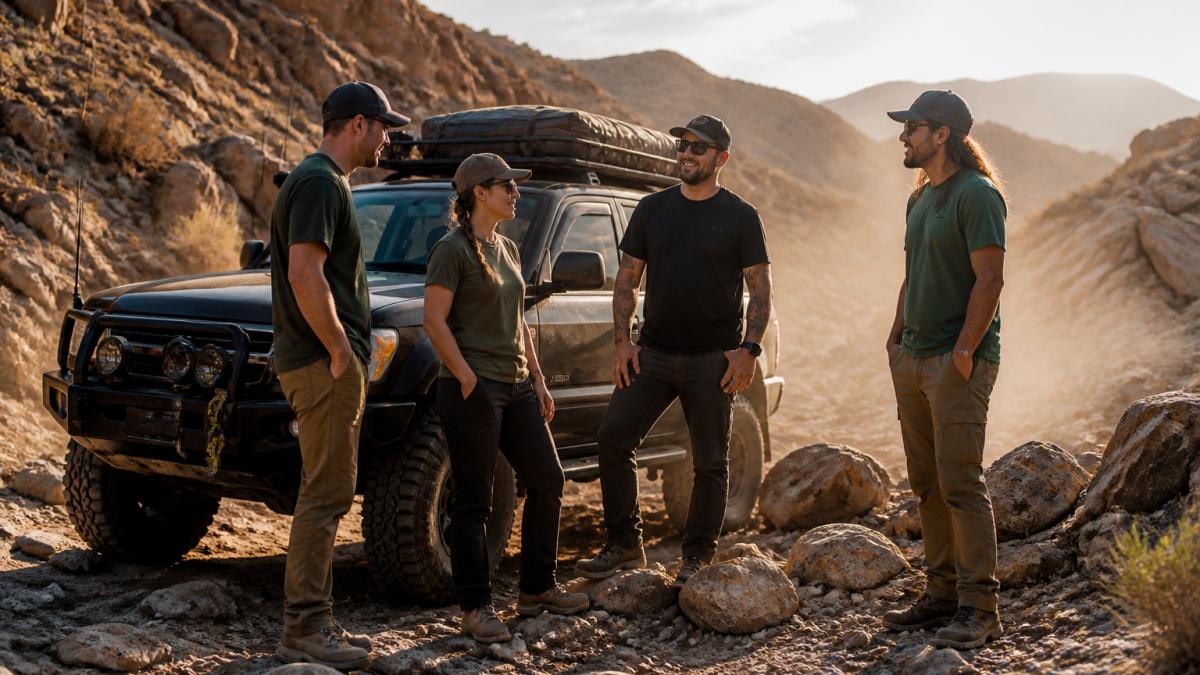
Below, we break down the two main riding styles and what each one asks of your clothing.
Rock Crawling and Slow Technical Trails
Slow trails reward durability over airflow. You spend hours in low range, brushing against rock, brush, and trees. Fabric snags, and seams take a beating.
Look for heavyweight cotton blends and reinforced stitching. Skip anything loose enough to catch on a shifter or a branch. Fit matters more here than anywhere else.
High-Speed Desert and Dune Runs
Fast runs are a wind and sun problem. Loose sand gets into everything. Sun exposure is constant.
Light, tightly woven layers work best. Long sleeves beat short sleeves for sun cover. A neck gaiter keeps grit out of your face without fogging your glasses.

What to Wear Off-Roading: The Core Pieces
What to wear off-roading comes down to four layers that work together: a base tee, a mid layer, a wind or sun shell, and accessories. Get these right and you can handle most trail days.
Start with a heavyweight tee as your base. Our Under Armour athletic t-shirt Cliffhanger uses a 60% cotton, 40% polyester blend at 7.41 oz./yd.², with a relaxed unisex fit and a split hem. It holds up to abrasion better than a thin fashion tee.

Add a fleece mid layer for cold mornings. The Unisex Columbia fleece jacket is 100% polyester MTR filament fleece at 7.4 oz./yd², with an athletic fit.

Top it with a visor or cap for sun, plus a neck gaiter for dust.
Fabric and Fit: What Actually Holds Up
Fabric weight is the number that predicts how long a garment survives trail abuse. Heavier fabric resists snags and abrasion. Lighter fabric breathes but wears faster.
Reading Fabric Weight and Blend
Fabric weight is listed in ounces per square yard (oz./yd.²). A 7 oz. tee is a heavyweight. A 4 oz. tee is a lightweight.
Check the blend too:
- Higher cotton: soft, breathable, wears faster
- Higher polyester: tougher, dries quicker, less breathable
- Spandex blends: stretch and recover, good for gaiters and visors
How Offroad Apparel Should Fit
Offroad apparel should fit close enough to avoid snags but loose enough to move. You are climbing in and out of a rig, reaching for a shifter, and ducking branches.
Check these points:
- Shoulders move freely without pulling
- Hem stays put when you bend
- Sleeves clear your wrists
- Nothing dangles near moving parts
If you are long-torsoed, check the size chart's body length, not just chest width.
Under ArmourⓇ athletic t-shirt Cliffhanger →
Off-Road Protective Gear You Should Not Skip
Off-road protective gear is the category people cut first to save money, and it is the one that matters most. Clothing protects against sun, brush, and grit. Real protection covers your head, eyes, hands, and ears.
Do not skip:
- Helmet for UTV and high-speed riding
- Eye protection for dust and debris
- Gloves for winch and recovery work
- Hearing protection for loud engines
- Sturdy boots with ankle support
Off-Road Clothing for Hot Weather
Off-road clothing for hot weather should cover more skin, not less. Sun exposure on an open trail is relentless, and a sunburned arm is a miserable passenger.
Pick light colors and loose, breathable weaves. Long sleeves in a lightweight fabric beat a tank top for a full day in the sun.
Accessories do a lot of work here. Our Neck Gaiter is a breathable polyester-spandex blend with two-way stretch. Wear it as a face cover, headband, or neck warmer. It is washable and reusable, and one size fits most.
For head cover, the Visor The Trail Explorer is a low-profile 97% polyester, 3% spandex option with a hook-and-loop closure.
Off-Road Apparel Layering for Changing Trail Conditions
Off-road apparel layering lets you adapt to a trail that changes elevation, shade, and weather in a single afternoon. The rule is simple: build up and peel down.
A three-layer system covers most days:
- Base: a heavyweight tee that manages sweat
- Mid: a fleece for cold mornings and shade
- Shell: a wind or sun layer you can stash
Common Mistakes to Avoid When Buying Offroad Apparel
Most buying mistakes come down to choosing looks over function. Here is what to watch for when you learn how to choose offroad apparel.
- Buying thin fashion tees that snag on the first brushy trail
- Skipping the size chart and guessing your fit
- Ignoring fabric weight and wondering why a shirt wore out in a season
- Skipping protection to save a few dollars
- Overbuying before you know your riding style
Conclusion
Choosing offroad apparel is really a matching exercise: fabric weight to trail type, fit to your body, and protection to your risk. Get those three right and the rest gets easy.
The Trail Explorer builds premium heavyweight tees and headwear for trail lovers, with designs focused on rock crawling and trail exploration. Our gear is made for people who spend real hours on trails.
Subscribe to our emails to hear first about new designs and trail-ready drops.
Frequently Asked Questions
What is the best fabric for offroad apparel?
Cotton-polyester blends hold up best for most trail riding. A 60/40 blend like the Under Armour Cliffhanger tee ($42.50) dries faster than pure cotton and resists abrasion better than polyester alone. For hot weather, look for breathable knits in the 6 to 8 oz./yd.² range. For cold mornings, a fleece midlayer such as the Columbia fleece jacket ($96.00) at 7.4 oz./yd.² adds warmth without bulk. Avoid thin fast-fashion cotton, which tears on brush and rock contact.
Do you need protective clothing for off-road riding?
Yes, even in a vehicle. Off-road protective gear matters most for riders on motocross bikes and ATVs, where a helmet, gloves, goggles, and abrasion-resistant pants are standard. For Jeep and side-by-side occupants, protection is more about sun, brush, and debris: long sleeves, a neck gaiter ($25.00) that doubles as a face covering, and closed-toe boots. Dust and flying rocks are the real hazards at trail speed, so cover exposed skin and keep eyewear handy.
What should you wear for off-road riding in hot weather?
Go light in color and weight, but stay covered. A breathable short-sleeve or lightweight long-sleeve tee in a cotton-poly blend, a low-profile visor ($33.95) for sun, and a neck gaiter you can wet down will keep you cooler than a tank top. Off-road clothing for hot weather should wick sweat and dry fast, so skip heavy denim and dark colors that soak up heat. Bring a light layer for shaded canyon sections where temperatures drop fast.
How should offroad apparel layering work for changing trail conditions?
Build three layers: a moisture-wicking base tee, an insulating midlayer like a fleece jacket, and a wind or rain shell you can stash. Off-road apparel layering works best when each piece fits over the one beneath it without binding at the shoulders or waist. Start cold and shed as you warm up. A trail that starts at 40°F in the morning can hit 80°F by noon, so pack the midlayer rather than wearing it all day.